Wednesday, February 22, 2006
The Music Theory Handbook
I found a very good book about Music Theory. It's the Music Theory Handbook, by Marjorie Merryman (ISBN 0-15-502662-3). It's a thin book that has lots of good things, including what I need!


Tuesday, February 14, 2006
Bluetooth
I was trying to get Bluetooth software to work these days. It's very complicated. And the documentation from software APIs is poor. And the documentation from hardware manufacturers is terrible. The examples are incomplete. The problem with Bluetooth doesn't seem to be related to the hardware. It seems to be related to the terrible software. The intention is good, though. The profiles are a nice idea. I just with they worked.
Monday, February 06, 2006
Topological spaces
"For any algebraic objects we can introduce the discrete topology, under which the algebraic operations are continuous functions. This leads to concepts such as topological groups, topological vector spaces, topological rings and local fields."
Kool! That means I can have a discrete topology and define continuous functions in it. And the continuous functions are the algebraic operations. And there's more: any function from a discrete topological space to another topological space is continuous.
Kool! That means I can have a discrete topology and define continuous functions in it. And the continuous functions are the algebraic operations. And there's more: any function from a discrete topological space to another topological space is continuous.
Thursday, January 26, 2006
Is there any merit or purpose in computing on discrete musical objects?
SVMs project the data from the original domain into some (possibly infinite) Hilbert space and then use a REAL-VALUED function f: X -> R for discrimination, so that if f(x) >= 0 then x is labeled positive class, and negative otherwise. f(x) is a linear discriminant in this projected Hilbert space (aka feature space), and thus can be expressed as an inner product in the feature space, so that f(x) = <> + b. Now skipping lots of details, in the original space, it can be shown that if your function is of the form f(x) = sum(i=l..m)a[m]y[m]k(x[m],x) + b and the kernel function k has certain properties you don't even need to know what is the mapping and it is guaranteed that it exists and that there's some inner-product space in that feature space. The codomain of this kernel function is either R (the reals) or C (complexes). (Be careful about the word "kernel" here. I still haven't figured out how the "kernels" in SVMs relate to "kernels" in algebra.)
So I thought: "Ok, if I can express musical objects as an inner-product, then I can let these SVMs compute directly on music". HOWEVER, I had a problem with the musical objects. Note that k: (X,X) -> R and k(x,x') = <> (phi is the projection from X to the Hilbert space). The inner product space is a vector space. A vector space is a module over a ring. In SVMs the ring is the field R, the reals. For this module, I can probably model my musical objects in the input domain X as an abelian group. My problem is the scalar multiplication of the module R x X -> X. How can I have the reals multiplying inherently discrete musical structures resulting in discrete musical structures and still maintain vector and scalar distributivity? For example, what does pi x {0,4,7} (a chord) mean?
Then I assumed that it wouldn't work this way. I began to think that perhaps I could form a free module over an ordered ring instead of a vector space, and create an inner-product using Milnor's definition of
inner product, which doesn't require the bilinear's codomain to be a field. That can take care of the domains in the SVM theory. But the theory only has R as the codomain. That's the assumption. I could try to see if I could enhance the SVM theory to allow Z as the codomain. Specifically, that amounts to taking a serious look at Mercer's theorem and finding alternative ways for the kernel function to fulfill certain properties assuming that the codomain is a commutative ring. But before going down that quest, I wonder if this is of any interest to the research community. Is it of interest to find ways to compute directly on musical objects? For instance, I remember how Elaine Chew projects the musical objects in that spiral in some continuous space, with some geometric calculations there. I remember David Temperley's center of gravity in the line of fifths, which again is non-discrete. I'm more interested in the discrete representations. I'll understand Mazzola after three reincarnations as a math PhD student, four as a musicologist and two as a philosopher (note: reincarnations somewhere in Europe, somewhere between France and Switzerland). But it seems that the foundation is so general that the musical objects may be represented by anything.
I see the nice discrete structures in the works from Mazzola, Andreatta, Forte and Noll. For me they are just there waiting for machines to compute directly on them by glueing their theories. But I still can't answer whether there's any merit, purpose or any benefit in doing that. I'm looking mainly for pragmatic answers to this question rather than philosophical answers (if possible). Comments are also welcomed.
So I thought: "Ok, if I can express musical objects as an inner-product, then I can let these SVMs compute directly on music". HOWEVER, I had a problem with the musical objects. Note that k: (X,X) -> R and k(x,x') = <> (phi is the projection from X to the Hilbert space). The inner product space is a vector space. A vector space is a module over a ring. In SVMs the ring is the field R, the reals. For this module, I can probably model my musical objects in the input domain X as an abelian group. My problem is the scalar multiplication of the module R x X -> X. How can I have the reals multiplying inherently discrete musical structures resulting in discrete musical structures and still maintain vector and scalar distributivity? For example, what does pi x {0,4,7} (a chord) mean?
Then I assumed that it wouldn't work this way. I began to think that perhaps I could form a free module over an ordered ring instead of a vector space, and create an inner-product using Milnor's definition of
inner product, which doesn't require the bilinear's codomain to be a field. That can take care of the domains in the SVM theory. But the theory only has R as the codomain. That's the assumption. I could try to see if I could enhance the SVM theory to allow Z as the codomain. Specifically, that amounts to taking a serious look at Mercer's theorem and finding alternative ways for the kernel function to fulfill certain properties assuming that the codomain is a commutative ring. But before going down that quest, I wonder if this is of any interest to the research community. Is it of interest to find ways to compute directly on musical objects? For instance, I remember how Elaine Chew projects the musical objects in that spiral in some continuous space, with some geometric calculations there. I remember David Temperley's center of gravity in the line of fifths, which again is non-discrete. I'm more interested in the discrete representations. I'll understand Mazzola after three reincarnations as a math PhD student, four as a musicologist and two as a philosopher (note: reincarnations somewhere in Europe, somewhere between France and Switzerland). But it seems that the foundation is so general that the musical objects may be represented by anything.
I see the nice discrete structures in the works from Mazzola, Andreatta, Forte and Noll. For me they are just there waiting for machines to compute directly on them by glueing their theories. But I still can't answer whether there's any merit, purpose or any benefit in doing that. I'm looking mainly for pragmatic answers to this question rather than philosophical answers (if possible). Comments are also welcomed.
Saturday, January 21, 2006
What is music? - wikipedia answers that (or does it?)
From Wikipedia, on the definition of music:
"[there are] those that seek a platonic or quasi-platonic ideal of music which is not rooted in specifically physical or mental terms, but in a higher truth. "
[...]
"The platonic ideal of music is currently the least fashionable in the philosophy of criticism and music, because it is crowded on one side by the physical view - what is the metasubstance of music made of, if not sound? - and on the other hand by the constructed view of music - how can one tell the difference between any metanarrative of music and one which is merely intersubjective? However, its appeal, finding unexpected mathematical relationships in music, and finding analogies between music and physics, for example string theory, means that this view continues to find adherents, including such critics and performers as Charles Rosen and Edward Rothstein."
"[there are] those that seek a platonic or quasi-platonic ideal of music which is not rooted in specifically physical or mental terms, but in a higher truth. "
[...]
"The platonic ideal of music is currently the least fashionable in the philosophy of criticism and music, because it is crowded on one side by the physical view - what is the metasubstance of music made of, if not sound? - and on the other hand by the constructed view of music - how can one tell the difference between any metanarrative of music and one which is merely intersubjective? However, its appeal, finding unexpected mathematical relationships in music, and finding analogies between music and physics, for example string theory, means that this view continues to find adherents, including such critics and performers as Charles Rosen and Edward Rothstein."
Friday, January 20, 2006
Music and Mathematics course
Here's the Syllabus of an Music and Mathematics course given by John Rahn. Kool stuff. Very kool stuff. All these algebraic structures are there waiting for us to compute directly on them.
http://faculty.washington.edu/jrahn/5752004.htm
http://faculty.washington.edu/jrahn/5752004.htm
Thursday, January 19, 2006
The research community doesn't understand the customer
Folks in the Machine Learning 'research community' could think a bit more about their 'customers'.
It's a generic problem in academic research. In private companies you learn fast that the customer is king. In the 'academic community', though, they are more interested in their own problems and tend to ostracize the applications and users.
For example, Machine Learning helps users classify/rank their data. It should help the users understand their problem domain. There are two areas that I don't see evolving in Machine Learning.
First in feature selection, their ultimate goal is to optimize the set of attributes for classification. But in doing so, the process can reveal a lot about the problem domain itself. I can't find much interpretation in the literature of how to utilize the result of feature selection to interpret the original problem domain. For instance, the literature uses a lot of Information Theory, but it doesn't show how much information the attributes convey conditionally on the class.
The second symptom of the problem is again the assumption that you are always dealing with the Euclidean space. Mercer's theory in SVM assumes a vector space. They definitely should work with better abstract algebra and category theory to redefine their theory, so that the machines can manipulate other objects directly.
It's a generic problem in academic research. In private companies you learn fast that the customer is king. In the 'academic community', though, they are more interested in their own problems and tend to ostracize the applications and users.
For example, Machine Learning helps users classify/rank their data. It should help the users understand their problem domain. There are two areas that I don't see evolving in Machine Learning.
First in feature selection, their ultimate goal is to optimize the set of attributes for classification. But in doing so, the process can reveal a lot about the problem domain itself. I can't find much interpretation in the literature of how to utilize the result of feature selection to interpret the original problem domain. For instance, the literature uses a lot of Information Theory, but it doesn't show how much information the attributes convey conditionally on the class.
The second symptom of the problem is again the assumption that you are always dealing with the Euclidean space. Mercer's theory in SVM assumes a vector space. They definitely should work with better abstract algebra and category theory to redefine their theory, so that the machines can manipulate other objects directly.
Tuesday, January 10, 2006
Rio de Janeiro - Elza Soares
Rio de Janeiro, gosto de você
Rio de Janeiro, gosto de você
Rio, Rio de Janeiro, cortado por montanhas
Mares desespero cortado por favela bala fuzila fuzileiro suicida dominantes das alturas guerrilheiros capitais
Guerrilheiros capitais
Formado o aparteid social que provoca o vazio preenchido pela droga
Da sociedade que explora o consumo ali do cidadão
Rio de Janeiro, gosto de você
Rio de Janeiro, gosto de você
Rio, Rio de Janeiro, cortado por montanhas
Mares de maneiro
Rio, Rio de Janeiro, cortado por montanhas
Mares de maneiro
Metropolitano brasileiro que mandou
Gasta dinheiro carioca de origem
Trabalha no sinal mas não metralha
Trabalha no sinal mas não metralha
Rio de Janeiro, gosto de você
Rio de Janeiro, gosto de você
Premiado pelo mundo simpatia tá na cara do turista enlouquecido na beleza guanabara
Premiado pelo mundo simpatia tá na cara do turista enlouquecido na beleza guanabara
I love, I love, I love, I love you
I love, I love, I love, I love you
Rio de Janeiro, gosto de você
Rio de Janeiro, gosto de você
Rio de Janeiro, gosto de você
Rio, Rio de Janeiro, cortado por montanhas
Mares desespero cortado por favela bala fuzila fuzileiro suicida dominantes das alturas guerrilheiros capitais
Guerrilheiros capitais
Formado o aparteid social que provoca o vazio preenchido pela droga
Da sociedade que explora o consumo ali do cidadão
Rio de Janeiro, gosto de você
Rio de Janeiro, gosto de você
Rio, Rio de Janeiro, cortado por montanhas
Mares de maneiro
Rio, Rio de Janeiro, cortado por montanhas
Mares de maneiro
Metropolitano brasileiro que mandou
Gasta dinheiro carioca de origem
Trabalha no sinal mas não metralha
Trabalha no sinal mas não metralha
Rio de Janeiro, gosto de você
Rio de Janeiro, gosto de você
Premiado pelo mundo simpatia tá na cara do turista enlouquecido na beleza guanabara
Premiado pelo mundo simpatia tá na cara do turista enlouquecido na beleza guanabara
I love, I love, I love, I love you
I love, I love, I love, I love you
Rio de Janeiro, gosto de você
Rio de Janeiro, gosto de você
Monday, January 09, 2006
Saturday, January 07, 2006
on kernels with integers as codomain and not a field, using Milnor's bilinear function
The problem of generalizing Kernels as functions with integers and not reals as codomain is in Mercer's theorem. The problem is that the theorem begins assuming that the Kernel function has the reals and complexes as codomain. Using Milnor's definition of a bilinear function that becomes an inner product space, and the non-degenerative restriction, I can construct a Kernel-like function that works with a free module instead of a vector space. But then, how can I be certain that it will have all the properties expected of a Kernel function for SVMs?
Wednesday, January 04, 2006
The Blank Sheet Desperation, The Student Nightmare
Among the worst despairs someone can have, one is called The Blank Sheet Desperation. It's the state of despair one faces in front of a blank sheet. It's because the person has all the ideas and has to start writing. The person has to have all the main ideas in order to begin. And how to encode correctly the ideas? Think of all the models that are isomorphic to the ones in your head.
This fear is similar to The Student Nightmare. The Student Nightmare is a dream like this: the student is in the classroom and doesn't remember there was a test. And then he/she gets The Test, and he/she knows no answer. It's a terrible nightmare. I read somewhere that it is The Student Nightmare because it happens to all students and there's no other nightmare that compares to it.
This fear is similar to The Student Nightmare. The Student Nightmare is a dream like this: the student is in the classroom and doesn't remember there was a test. And then he/she gets The Test, and he/she knows no answer. It's a terrible nightmare. I read somewhere that it is The Student Nightmare because it happens to all students and there's no other nightmare that compares to it.
Céu, sol, sul
Eu quero andar nas coxilhas sentindo as flexilhas das ervas do chão
Ter os pés roseteado de campo ficar mais trigueiros como o sol de verão
Fazer versos cantando as belezas dessa natureza sem par
E mostrar pra quem quizer um lugar pra viver sem chorar
É o meu Rio Grande do Sul céu, sol, sul terra e cor
Onde tudo que se planta cresce o que mais floresce é o amor
É o meu Rio Grande do Sul céu, sol, sul terra e cor
Onde tudo que se planta cresce o que mais floresce é o amor
Eu quero me banhar nas fontes e olhar horizontes com Deus
E sentir que as cantigas nativas continuam vivas para os filhos meus
Pelos campos florindo e crianças sorrindo, felizes a cantar
E mostrar pra quem quizer um lugar pra viver sem chorar
Ter os pés roseteado de campo ficar mais trigueiros como o sol de verão
Fazer versos cantando as belezas dessa natureza sem par
E mostrar pra quem quizer um lugar pra viver sem chorar
É o meu Rio Grande do Sul céu, sol, sul terra e cor
Onde tudo que se planta cresce o que mais floresce é o amor
É o meu Rio Grande do Sul céu, sol, sul terra e cor
Onde tudo que se planta cresce o que mais floresce é o amor
Eu quero me banhar nas fontes e olhar horizontes com Deus
E sentir que as cantigas nativas continuam vivas para os filhos meus
Pelos campos florindo e crianças sorrindo, felizes a cantar
E mostrar pra quem quizer um lugar pra viver sem chorar
Monday, January 02, 2006
Schenkerian Analysis
It would be nice to have my system to compare the results of genre classification between one piece and one of its Schenkerian reductions. But I can't find any MIDI file or any encoding that has the Schenkerian version. If you find one, let me know!
Wednesday, December 28, 2005
Thomas Noll
Here are some very good articles by Thomas Noll.
Topos Of Triads
Facts and Counterfacts
Mathematical Contributions to Music-theoretical Knowledge
Very good.
Topos Of Triads
Facts and Counterfacts
Mathematical Contributions to Music-theoretical Knowledge
Very good.
Tuesday, December 27, 2005
Perspectives in mathematical and computational music theory
I'm adding some more books to read AFTER my Thesis
Title: Perspectives in mathematical and computational music theory / [edited by] Guerino Mazzola, Thomas Noll, and Emilio Lluis-Puebla.
Publisher: Osnabrück : Epos, Electronic Pub. Osnabrück : University of Osnabrück, c2004.
ISBN 392348657X
And two other books on Topology:
Experiments in Topology by Stephen Barr, and General Topology by John L. Kelley
Maybe one of these two books will make Topology accessible to me, with good examples (and figures)
Title: Perspectives in mathematical and computational music theory / [edited by] Guerino Mazzola, Thomas Noll, and Emilio Lluis-Puebla.
Publisher: Osnabrück : Epos, Electronic Pub. Osnabrück : University of Osnabrück, c2004.
ISBN 392348657X
And two other books on Topology:
Experiments in Topology by Stephen Barr, and General Topology by John L. Kelley
Maybe one of these two books will make Topology accessible to me, with good examples (and figures)
Monday, December 19, 2005
Java and Web Services
I just downloaded the Java package for web services - the Java Web Services Developer Pack. I couldn't use it. I just want to write a web services client out of a WSDL. I just want to generate the client. But I have to download a big J2EE web container. Then I need to understand how a certain service registry works. Then I'll need to have all that going and launching here and there from command line. Then I'll have to fight with CLASSPATHs including 1001 .jar files, and version of this XML package, and that other one. And after 10 hours it won't work. I hope it's easier with Microsoft .NET. I wish I could import the WSDL in Visual Studio .NET, or run some kind of wizard there.
Saturday, December 17, 2005
www.ontologicalreviews.com
I should patent the idea quickly. www.ontologicalreviews.com will be a big hit. Now the elections campaign is ongoing. In www.ontologicalreviews.com people would be able to assess their candidates better. They could get 'best voted' formulas. They could vote on the evaluation formulas themselves too. Besides the canned reports, people would be able to use an applet or an ActiveX control to easily increase/decrease the parameters and assess the alternatives. Just imagine a control labeled 'Gomery scandal damage' and a percentage besides it. Or 'spending with military' - 15 % (default or best voted percentage) , 'environmental platform' - 5 % (default or best voted percentage), 'National unity' - 20 %, etc
Capitalism vs Socialism
"In capitalism men exploit men. In socialism it's the other way around." ( I don't know the source )
Wednesday, December 14, 2005
On beeing a "cold" Canadian
As typical north-americans, Canadians can be seen as 'colder' in general than Brazilians. Not that being "colder" is bad. Not at all! It's just different from other cultures. At least with regards to public behaviour. I think two things contribute to this behaviour:
- cold weather and driving distances. Because the weather is colder, people interact with each other in different ways. Canadians don't just hang outside during Winter... So it's natural to interact differently with people. Driving distances are also responsible in part for the 'problem'. If you walk around your neighbourhood odds are you'll get to know your neighbours better. I have a feeling that Canadians hate smalltalk with neighbours.
- static chocks. Yes, static chocks make Canadians "colder" people towards each other. That's because you avoid kissing other people because of static chocks.
- cold weather and driving distances. Because the weather is colder, people interact with each other in different ways. Canadians don't just hang outside during Winter... So it's natural to interact differently with people. Driving distances are also responsible in part for the 'problem'. If you walk around your neighbourhood odds are you'll get to know your neighbours better. I have a feeling that Canadians hate smalltalk with neighbours.
- static chocks. Yes, static chocks make Canadians "colder" people towards each other. That's because you avoid kissing other people because of static chocks.
Friday, December 09, 2005
www.ontological-product-reviews.com
Again, continuing on the list of things to do after a Master thesis, here is the web site that allows people to quantitatively evaluate products (and governments!! and companies!! and soccer players!!) This will be kool! Think of two layers of the site exposed. One lower layer provides primitives that allow the computation and creation of formulas based on raw ontologies. The upper layer is for the average Joe, with reviews, grades about products, alers, averages, rich searches, historical trends. The election of the criteria deserves some attention. Beeing free to have the evaluation criteria itself to be an ontology would be kool! But perhaps too flexible to start with in a commercial product? Hey, I can foresee books on Amazon.com about how to use the service. The only thing is how to make money out of it... Isn't that a nice open-source project?
things to do after a Master's thesis
Here is the to-do list for life after a Thesis (if it exists):
- buy an electric guitar and learn to play it
- buy an electric bass guitar and learn to play it well
- create a web site for product reviews using and abusing of ontologies (taxonomies perhaps).
- swim regularly
- learn French well
- write a book about Rhythm and Mathematics
- become a Human Rights activist (a 'missionary' to the american Christians)
- buy an electric guitar and learn to play it
- buy an electric bass guitar and learn to play it well
- create a web site for product reviews using and abusing of ontologies (taxonomies perhaps).
- swim regularly
- learn French well
- write a book about Rhythm and Mathematics
- become a Human Rights activist (a 'missionary' to the american Christians)
New York, New York
New York, New York! The land of consumerism! In this trip to New York it became apparent how much americans love consumerism. It's a big push on everybody to buy and buy and buy. Especially this time of the year, near Christmas. Before I used to think that the idea of city identities, or costumes wasn't valid. I thought that humans shared common basic needs and aspirations, and the culture of cities was just a matter of perception and marketing. I think I was wrong. Take driving, for instance. Driving in New York is bad and drivers don't respect each other. But it's not as bad as Montreal. And São Paulo in Brazil is worst than New York. And here in Ottawa everybody behave behind theirwheelss. But back to consumerism, geez! They find ways to really spend money for things of little value. It's the proof that individualism, capitalism and consumerism prevails in the U.S.
Wednesday, November 23, 2005
Language comparisons
Continuing with the comparisons: Perl is German, Dutch is awk. I remember one quote now from a quotation service delivered by email. The guy wrote something like this: "I speak with French with men, Italian with women, Spanish with God and German with my dog".
Prophecies - I
I prophecy that RDF will be a de facto standard as popular as pure XML. I prophecy that SPARQL will be used a lot. I prophecy that network management will use some kind of ontology-based representation of the devices and their capabilities. I prophecy that agents will use inference over the network data to heal network deficiencies. I don't believe in mobile agents, but once in a while I think of scenarios in networking where 'mobile', scripted agents roam the network for various functions, like healing and diagnostics. Or for dynamic functions, like dynamically loading drivers, etc.
Thursday, November 17, 2005
Voz, Guilherme Kerr, Jorge Rehder
da Canata Luz
Voz do que clama no deserto,
Prepara o caminho do Senhor,
Chama essa gente,
É hoje o tempo de retornar a Deus
Voz do que clama no deserto,
Prepara o caminho do Senhor,
Chama essa gente,
É hoje o tempo de ouvir a voz de Deus
O sol se levanta com seu ardente calor,
A erva seca e cai sua flor,
Mas a Palavra do Senhor
Existe para sempre
O sol se levanta com seu ardente calor,
Verá a terra a glória do Senhor
Verá a terra a glória do Senhor
Voz do que clama no deserto
Voz do que clama no deserto,
Prepara o caminho do Senhor,
Chama essa gente,
É hoje o tempo de retornar a Deus
Voz do que clama no deserto,
Prepara o caminho do Senhor,
Chama essa gente,
É hoje o tempo de ouvir a voz de Deus
O sol se levanta com seu ardente calor,
A erva seca e cai sua flor,
Mas a Palavra do Senhor
Existe para sempre
O sol se levanta com seu ardente calor,
Verá a terra a glória do Senhor
Verá a terra a glória do Senhor
Voz do que clama no deserto
Monday, November 14, 2005
Mobius strip
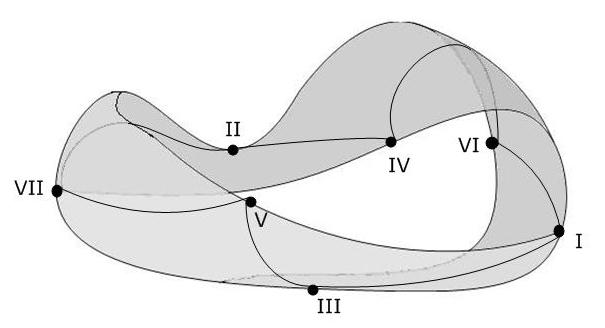
I was really glad to be able to create my own harmonic distance using a Mobius 'harmonic' stip. In using some of Mazzola's and Schonberg's ideas I was able to integrate Humdrum extra harmonic analyzer along with Melisma, and created my own measurement of harmonic distance for a piece of music. The basic idea is that jumping from degree to degree the person walks in the Mobius strip. I then measure the average distance per harmonic change. That's cool!
Humdrum extra extras, Melisma
Ok, I was able to fix the problem with Humdrum and Melisma. Something happened within tsroot for certain Syphonies that produced bad input to Melisma. It seems to be related to the transformation of time between the Melisma format and Humdrum format, which is handled by a Perl script. I was able to use grep to take out these bad lines. Then the 'key' tool in Melisma was blowing up. It just so happened that it holds everything in memory, and a Symphony was blowing up! I had to increase the amount of memory for the data structures, and it was able to go ahead and do its job. Oh boy...
Friday, November 11, 2005
Humdrum extras or coding problem
Now I have a problem with the "Humdrum Extras" package. It's either a bug in the package, or a problem in the encoding of Hydn's Symphonie Nr. 100. I knew that the loose ASCII-based encoding mixed with regular expressions and shell scripts would give this kind of problem sooner or later. There's some grammatical problem with mixing all these musical layers into one flat file. Now I'm left with a problem saying "error: trailing tab character in line: |". Right, that's very helpful... :( And I searched the original text file of the Symphony and there's no one line with just a 'pipe' character. I'll see what I'll do... Why didn't they code this in XML to begin with?
Monday, November 07, 2005
The Melisma Music Analyzer
I just downloaded the " Melisma Music Analyzer" from http://www.link.cs.cmu.edu/music-analysis/. Cool! And I could compile it withouth problems on Windows using Cygwin. Let's see if now I can get tsroot from humdrum extras to do some musical analysis for me now!
Tuesday, October 25, 2005
left behind III
I didn't like the movie. I went to see it in its debut last Friday with the Church's Youth group. What an American bias to the whole idea of world! Jez! The UN is the Devil, and will be there to persecute the (american) christians. Jez! And the Devil speaks Russian! And the Chinese are in the Axil of Evil! Oh boy, that's bad, very bad. The scene where they show the poison being sprinkled over the Bibles is just ridiculous. At the end, I didn't get why there was war. Of course there needs to be war and terror. The movie plays with the feelings of insecurity in the minds of the american christians to manipulate them in their world-view. I just don't see the point in discussing and showing terror 'in the future', as if there were no terror here and now. Just look at children dying of AIDS/HIV daily. That's terror. That's the true Left Behind that the american christians don't want to see.
Thursday, October 20, 2005
Humdrum using Cygwin
I'm very impressed with Humdrum. It seems to be a nice software created by musicians for musical analysis! It seems that again no 'computer scientist' was excited to give a hand to the project. I suspect that because the installation and documentation are somewhat obscure. Here is how one can install Humdrum using Cygwin:
1- change 'uncompress' to 'gunzip -d' in humunix
3- create an empty .profile file somewhere - say /thesis/humdrum1.0/
2- do an install.ksh linux
4- change .profile to be something like
export TMPDIR; TMPDIR=/tmp
export HUMDRUM; HUMDRUM=/thesis/humdrum1i
export AWK_VER; AWK_VER=awk
export CON; CON=/thesis/humdrum1.0/error
PATH=/thesis/humdrum1i/bin:$PATH
( replace proper path to humdrum )
Notice that CON points to a file called error (you have to create this file)
5 - issue make commands separately for each subdirectory under csource.
6- for each command above, copy the executable to the bin directory
7- copy all executables in csource.dos to the bin directory.
I couldn't get MIDI and perform to work yet... You may find some other problems here and there. The procedure above hasn't been fully tested.
1- change 'uncompress' to 'gunzip -d' in humunix
3- create an empty .profile file somewhere - say /thesis/humdrum1.0/
2- do an install.ksh linux
4- change .profile to be something like
export TMPDIR; TMPDIR=/tmp
export HUMDRUM; HUMDRUM=/thesis/humdrum1i
export AWK_VER; AWK_VER=awk
export CON; CON=/thesis/humdrum1.0/error
PATH=/thesis/humdrum1i/bin:$PATH
( replace proper path to humdrum )
Notice that CON points to a file called error (you have to create this file)
5 - issue make commands separately for each subdirectory under csource.
6- for each command above, copy the executable to the bin directory
7- copy all executables in csource.dos to the bin directory.
I couldn't get MIDI and perform to work yet... You may find some other problems here and there. The procedure above hasn't been fully tested.
Sunday, October 16, 2005
Trocando uma torneira que pinga
Fui consertar uma torneira que pinga hoje. Que coisa! Essas instruções de engenheiros são muito complicadas. Empaquei na estapa de tirar o cartucho de dentro da torneira. O negócio não saía, e acabei quebrando uma parte de acrílico do próprio cartucho. No final das contas, com muita força, consegui tirar o negócio. Moen é o nome do fabricante. Que instruções ruins! Não tinha texto nenhum, e as figuras de uns 4 tipos de torneiras não batiam com a que eu tinha.
Friday, October 14, 2005
MuseData is online
MuseData is online. I only had to log in. It would be much better if the site told me that I had to log in to have access to the music, instead of just giving a 404 error. No wonder 'regular' people hate computers.
Sunday, October 09, 2005
MuseData is offline
MuseData (http://www.musedata.org) is one of the only two music databases that contains music for analysis. And now it's not working. Trying to get a file gives an HTTP 404 error. URLs just shouldn't be changed. They point to things on the Internet, and HTTP 404 is a bad error.
Friday, October 07, 2005
Java is Spanish, C++ Portuguese
Java is Spanish, C++ Portuguese. Do I get confused with both (or the 4)?! As someone said, Portuguese is not that important anyways... It's only more convenient to speak Portuguese if you were born listening to it.
Thursday, October 06, 2005
University of Ottawa
If you are looking for a University to persue your graduate studies in Canada, don't choose the University of Ottawa. I haven't had any support from it. I have no funding as a part-time student. The only request for travel that I had was denied because I wasn't a full-time student. I ended up paying to go to the conference in Europe out of my own pocket (ouch). My supervisor quit the university and went to Laval. He was very honest saying that the University here didn't have fair ways to evaluate the professor's performance. The Director of the Faculty of Computer Science was kind enough not to reply to my request to take credit for a course I took before formally registering in the program. Then this same director rejected my thesis title, saying that I had to have a supervisor locally from the University, despite the fact that my supervisor was still an adjunct professor at the University of Ottawa.
Tuesday, October 04, 2005
SVMlight and research community
This SVM-Light implementation for Support Vector Machines is complicated. First, the kernel function again expects a codomain in the real field. I wish that was generalized to commutative rings, like integers.
And the "research community" is a strange thing. They seem to be isolated in their own world. I remember asking for simple help and collaboration from more than one 'researcher', and got no reply. I asked the University of Ottawa for funding to travel to a conference, and it wasn't granted to non-full-time students. As if part-time students had money to go to conferences. I see these papers that talk, talk and don't mean much. I really wonder where are the so-called research grants.
And the "research community" is a strange thing. They seem to be isolated in their own world. I remember asking for simple help and collaboration from more than one 'researcher', and got no reply. I asked the University of Ottawa for funding to travel to a conference, and it wasn't granted to non-full-time students. As if part-time students had money to go to conferences. I see these papers that talk, talk and don't mean much. I really wonder where are the so-called research grants.
Sunday, October 02, 2005
Discrete SVMs
I think that there is the possibility of defining discrete Support Vector Machines.
It's unfortunate that all SVM theory as I read it assumes that the codomain of the kernel function
is the Eucludean space. Although the theory will often say that the input space can be any countable set, the examples and implementations seem to assume too often that you got R as your input space. And why not use a free module instead of a vector space? It seems to me that all of this can be generalized to allow for discrete spaces. That would be interesting! Maybe someone in the future will be able to define the musical structures in algebraic terms, or using a topology, and then allow a machine to operate directly on the music pieces. Not allowing the use of discrete spaces for me restricts the applicability of the SVM theory to other inputs that are countable in ways other than the field of the reals.
It's unfortunate that all SVM theory as I read it assumes that the codomain of the kernel function
is the Eucludean space. Although the theory will often say that the input space can be any countable set, the examples and implementations seem to assume too often that you got R as your input space. And why not use a free module instead of a vector space? It seems to me that all of this can be generalized to allow for discrete spaces. That would be interesting! Maybe someone in the future will be able to define the musical structures in algebraic terms, or using a topology, and then allow a machine to operate directly on the music pieces. Not allowing the use of discrete spaces for me restricts the applicability of the SVM theory to other inputs that are countable in ways other than the field of the reals.
Saturday, October 01, 2005
taxonomy instead of DNS
Is it possible to have a directory service based on a taxonomy instead of DNS? It would be interesting for the Internet to have a service that allows one to make a query based on a hierarchical taxonomy. I think that we could redesign the DNS service to be based on a taxonomy. The implementation would be much more elegant. And perhaps, a semantic web service would be able to make new derivations on the fly and provide an intelligent directory service. That would interesting.
Saturday, September 24, 2005
Knowledge Representation: Logical, Philosophical, and Computational Foundations
Ok, now it's the second time I write this stuff. It's about this book:
Knowledge Representation: Logical, Philosophical, and Computational Foundations
ISBN: 0534949657
by John F. Sowa
This is one of my favorites. It's a very good book. Particularly, I like the part on logics, and their representation. It reminded me a lot of the classes I had in Computer Science avec professor Vanderley at UFRGS. One of the nice parts is that one where the guy rewrites geometrical axioms with circles because of (philosophical? Metaphysical?) flaws in the traditional geometrical definitions of point, line and squares. The parts on deontic logic are kool! This whole book is kool! One day when I have money I'll buy it. Thank goodness for the library!
Knowledge Representation: Logical, Philosophical, and Computational Foundations
ISBN: 0534949657
by John F. Sowa
This is one of my favorites. It's a very good book. Particularly, I like the part on logics, and their representation. It reminded me a lot of the classes I had in Computer Science avec professor Vanderley at UFRGS. One of the nice parts is that one where the guy rewrites geometrical axioms with circles because of (philosophical? Metaphysical?) flaws in the traditional geometrical definitions of point, line and squares. The parts on deontic logic are kool! This whole book is kool! One day when I have money I'll buy it. Thank goodness for the library!
Subscribe to:
Posts (Atom)