Showing posts with label Ottawa. Show all posts
Showing posts with label Ottawa. Show all posts
Sunday, September 08, 2013
Meeting with the Humanist Association of Ottawa
The last visit of the 2012-2013 year of the "Getting to Know Our Neighbour's Faith" small group of the Ottawa Mennonite Church was with the Humanist Association of Ottawa. We met at Patty's Pub in June 2013. There were about 5 people from HAO and 6 people from the OMC. I tried to frame the discussion as an interview, trying to get to know their history and how they view religion overall. I was personally a bit afraid of what to expect from the conversation, mostly by people from our group. That is because, speaking generally, Christians are not very used to the idea of 'not defending their ideas' of G*d, and I didn't know how it would go. I don't want to write publicly about some details of their relationship with religion, but I want to say that I wish that, generally speaking, there were more gentle and more respectful relations between religious groups and atheists/humanists. More than that, I think that, in general, these "positions" have an opportunity to move beyond 'tolerance' or 'respect' and walk a path of embrace, arriving at some point at political cooperation. And then after (or in the meantime), to move to push the boundaries of philosophy. I should not have expectations that this should be the path of institutions, but it would be interesting to see local groups in such a process.
I learned that our humanist friends do have lots of assertions about who G*d is and who G*d is not. That looked like theology to me. It was also interesting to see how they use science to oppose ideas of G*d. I see these positions in the context of negative views by religious people of non-religious people. I know regrettable notions that judge non-religious or atheists as morally inferior than religious people. That is really unfortunate. And so, I noticed a certain 'spirit of counter-attack' by our atheist friends as they spoke about science exposing religion. They use science as a good tool to expose religion. There may be other tools too. I just think that there's the risk of "having too much faith in science". I don't think that science will help us in the search for meaning and solidarity in the future. There may be a philosophical debate about the intersection of science and ethics, but regardless of theism or atheism, we may need to carve new languages to talk about meaning and solidarity with the help of the Humanities and Social Sciences (ok, here we go, it's yet another science...). The other interesting thing to note was that "the question" was important to some of them. That is, even though they do not "believe in G*d", the "question of G*d" is still important to some of them. Why would this question follow them? In my mind, I thought of another position: that which would see "religion" as irrelevant. In that view, the "a" in "atheism" would be that of indifference towards "religion". And that's an interesting position that confronts a deeper question.
I was also pleased to see how humanitarian solidarity moves them to help. They plan concrete and active political actions based on their principles. These are concrete and important actions not only at the city, but in different places of the world. And I admired that.


Wednesday, June 05, 2013
Visit to the Ottawa Mosque


On the 26th of May of 2013 the "Getting to Know Our Neighbour's Faith" small group from the Ottawa Mennonite Church visited the Ottawa Mosque. We were welcomed by Imam Samy Metwally. We heard about the basic beliefs of Islam. And we had a good conversation after. We learned that one of the pillars of Islam is charity. And we learned that our Muslim brothers and sisters are also actively working within the society. We also heard beautiful stories of inter-faith dialogue and action with our Muslim brothers and sisters.
Monday, January 28, 2013
Visit to the First Unitarian Congregation of Ottawa
I heard the Minister of the First Unitarian Congregation of Ottawa speak for 2 minutes at an ecumenical meeting last year and I liked what I heard. That's when I read a bit about the history of the Unitarians and Universalists in North America and planed the visit with the small group. This report speaks about the series of visits of our small group from the Ottawa Mennonite Church called "Getting to Know Our Neighbour's Faith".
One thing that first caught my attention when I heard Kye speak last year was the fact that they didn't have a statement of faith. Also around the end of 2012 I got to know another person from the congregation that was at the "founding" meeting of the Ottawa Network of Spiritual Progressives. We had a very interesting conversation. She told me that she was an ex-Hindu who went to a Catholic school. And she is a lesbian. She converted to Christianity within the Unitarian Universalists. One of the most important aspects of a faith community for her was the fact that she can count on them with practical help when in need, regardless of the faith they might profess.
I was anxious to meet he Unitarians to know their history and understand how they relate to the various labels of religion. Their temple has a beautiful architecture with big glassed windows viewing the Ottawa river. Their afternoon service was warm and informal. It was a group of about 40 people. The small sermons were given by three young people. (I liked the way they dressed. Some details in some looked "counter-cultural"... these small details matter!) They seemed knowledgeable, thoughtful and authentic. Each preacher spoke a bit about their 'heroes'. Kye spoke about the "Justice League", a network of amazing women who are activists.
The conversation after the service was the most interesting part. It so happens that they too were interested in knowing more about Mennonites. I knew that was going to happen! We agreed that each one in the table would say some words about what drew him/her to his/her faith tradition.
One of the ministers said that she was raised a Methodist but she decided to "clear it all" and "restart". She then did some meditation and Yoga as part of an 'experimentalist phase'. And today she considers herself an agnostic. That's very interesting! An agnostic pastor!
We heard from a former Catholic. He was trained for many years in seminary in the United States. I was encouraged to hear his story of political activism in the streets of Washington! He was there in basements being trained (his own words) by Quakers and others. He and others rejected military drafts as conscientious objectors during the Vietnam war. I thought to myself 'this man has more history of active peacemaking than all Mennonites together in this table'! He said that at one point he was at a birthday party and said he was a Unitarian and the other person replied: "I know you guys. You are a bunch of atheists who happen to go to church". He said he wasn't very happy to hear that at first, but then thinking about it he said "yes, you are right"...
We heard from a retired Unitarian Minister who was a pioneer in Alberta. He was a Minister with the United Church of Canada. But then he came to the conclusion that he could not anymore accept the Basis of Union doctrine statements and maintain his integrity (in his own words). He then wrote a letter to colleagues and was questioned. They told him to "get his act together". And he replied something like "I don't want to and I cannot get my act together". He then left Ministry there and went on to teach English for many years. From what I understood he was also the president of a Canadian Humanist association for some time.
I learned that the Unitarian Universalists intentionally don't have a faith statement. They leave to the individuals to follow their own paths. They do have some written principles that hold them together.
I was really glad to learn about the group and their history. And I'll leave my comments at that.
This is their web site: http://www.firstunitarianottawa.ca/ .
We sang a nice song at the end of the service called "Woyaya".
We are going
Heaven knows where we are going
We will know we're there
We will get there
Heaven knows how we will get there
We know we will
It will be hard we know
And the road will be muddy and rough
But we'll get there
Heaven knows how we will get there
We know we will
We are going
Heaven knows where we are going
We will know we're there
One thing that first caught my attention when I heard Kye speak last year was the fact that they didn't have a statement of faith. Also around the end of 2012 I got to know another person from the congregation that was at the "founding" meeting of the Ottawa Network of Spiritual Progressives. We had a very interesting conversation. She told me that she was an ex-Hindu who went to a Catholic school. And she is a lesbian. She converted to Christianity within the Unitarian Universalists. One of the most important aspects of a faith community for her was the fact that she can count on them with practical help when in need, regardless of the faith they might profess.
I was anxious to meet he Unitarians to know their history and understand how they relate to the various labels of religion. Their temple has a beautiful architecture with big glassed windows viewing the Ottawa river. Their afternoon service was warm and informal. It was a group of about 40 people. The small sermons were given by three young people. (I liked the way they dressed. Some details in some looked "counter-cultural"... these small details matter!) They seemed knowledgeable, thoughtful and authentic. Each preacher spoke a bit about their 'heroes'. Kye spoke about the "Justice League", a network of amazing women who are activists.
The conversation after the service was the most interesting part. It so happens that they too were interested in knowing more about Mennonites. I knew that was going to happen! We agreed that each one in the table would say some words about what drew him/her to his/her faith tradition.
One of the ministers said that she was raised a Methodist but she decided to "clear it all" and "restart". She then did some meditation and Yoga as part of an 'experimentalist phase'. And today she considers herself an agnostic. That's very interesting! An agnostic pastor!
We heard from a former Catholic. He was trained for many years in seminary in the United States. I was encouraged to hear his story of political activism in the streets of Washington! He was there in basements being trained (his own words) by Quakers and others. He and others rejected military drafts as conscientious objectors during the Vietnam war. I thought to myself 'this man has more history of active peacemaking than all Mennonites together in this table'! He said that at one point he was at a birthday party and said he was a Unitarian and the other person replied: "I know you guys. You are a bunch of atheists who happen to go to church". He said he wasn't very happy to hear that at first, but then thinking about it he said "yes, you are right"...
We heard from a retired Unitarian Minister who was a pioneer in Alberta. He was a Minister with the United Church of Canada. But then he came to the conclusion that he could not anymore accept the Basis of Union doctrine statements and maintain his integrity (in his own words). He then wrote a letter to colleagues and was questioned. They told him to "get his act together". And he replied something like "I don't want to and I cannot get my act together". He then left Ministry there and went on to teach English for many years. From what I understood he was also the president of a Canadian Humanist association for some time.
I learned that the Unitarian Universalists intentionally don't have a faith statement. They leave to the individuals to follow their own paths. They do have some written principles that hold them together.
I was really glad to learn about the group and their history. And I'll leave my comments at that.
This is their web site: http://www.firstunitarianottawa.ca/ .
We sang a nice song at the end of the service called "Woyaya".
We are going
Heaven knows where we are going
We will know we're there
We will get there
Heaven knows how we will get there
We know we will
It will be hard we know
And the road will be muddy and rough
But we'll get there
Heaven knows how we will get there
We know we will
We are going
Heaven knows where we are going
We will know we're there
Visit to St. Joseph's Parish in Ottawa
The second visit of our "Getting to Know Our Neighbour's Faith" small group of the Ottawa Mennonite Church was to the St. Joseph's Parish downtown.We scheduled to go to the Saturday Mass in December.
It was a nice mass. I'm not "trained" in the sacramental liturgy, so it's interesting to note how easy it is for others to respond as if it's automatic. The friend who came with me knew a lot about liturgy, and commented how many details show how 'progressive' is the parish. I couldn't notice these subtleties. I did notice that the sermon was delivered by a lay person. And it was very good. His words spoke to me when talking about joy in the midst of troubles. I liked his literary style.
I tried to organize some kind of conversation about the Catholic faith by emailing Fr. Boyer in advance. He replying saying he would be available after the service for conversation. We ended up not talking to him after the service, but talking mostly within our group.
I told my friend that I get mixed messages when I enter a Catholic church. In the back of my mind there are accusations of carrying on the Inquisition and burning many at the stake, of supporting the massacre of natives in Latin America, of symbiosis with power in Europe, of its dogmatic positions, of its undemocratic hierarchy, of idolatry and indulgences, of plain and simply stealing gold from Latin America taking it to Europe, of exclusion of women and LGBTs, and of systematically undermining Liberation Theology in Latin America. On the other hand, it is a religion of Bartolomé de las Casas, Oscar Romero, Leonardo Boff and Dorothy Day. And by the way, Oscar Romero and Dorothy Day were mentioned by Father Andy Boyer during the Eucharist.
But is the Catholic church any different from other big institutions?
If I think of it, it's not healthy for me to be 'eaten from the inside' by caustic feelings against the Catholic Church. In one sense, I'm not directly involved with it. All I can do is wish it luck. Good luck, Catholic Church! And let many more Dorothy Day's and Oscar Romero's arise.
It was a nice mass. I'm not "trained" in the sacramental liturgy, so it's interesting to note how easy it is for others to respond as if it's automatic. The friend who came with me knew a lot about liturgy, and commented how many details show how 'progressive' is the parish. I couldn't notice these subtleties. I did notice that the sermon was delivered by a lay person. And it was very good. His words spoke to me when talking about joy in the midst of troubles. I liked his literary style.
I tried to organize some kind of conversation about the Catholic faith by emailing Fr. Boyer in advance. He replying saying he would be available after the service for conversation. We ended up not talking to him after the service, but talking mostly within our group.
I told my friend that I get mixed messages when I enter a Catholic church. In the back of my mind there are accusations of carrying on the Inquisition and burning many at the stake, of supporting the massacre of natives in Latin America, of symbiosis with power in Europe, of its dogmatic positions, of its undemocratic hierarchy, of idolatry and indulgences, of plain and simply stealing gold from Latin America taking it to Europe, of exclusion of women and LGBTs, and of systematically undermining Liberation Theology in Latin America. On the other hand, it is a religion of Bartolomé de las Casas, Oscar Romero, Leonardo Boff and Dorothy Day. And by the way, Oscar Romero and Dorothy Day were mentioned by Father Andy Boyer during the Eucharist.
But is the Catholic church any different from other big institutions?
If I think of it, it's not healthy for me to be 'eaten from the inside' by caustic feelings against the Catholic Church. In one sense, I'm not directly involved with it. All I can do is wish it luck. Good luck, Catholic Church! And let many more Dorothy Day's and Oscar Romero's arise.
Sunday, November 11, 2012
Visit to St George & St Anthony Coptic Orthodox Church
We just started the "Getting to Know our Neighbour's Faith" small group at the Ottawa Mennonite Church. Today was our first visit. We went to St. George & St. Anthony Coptic Orthodox Church. Their website is http://www.orthodoxy.ca/ . It was a beautiful liturgy. We were welcomed by Fr. Mikhail Fam and Fr. George Mikhail, who invited us to stay after the service and talk, and connect during the week if we wanted.
Some personal impressions:
- I didn't quite know what to expect when I arrived. The uncertainty of the unknown at times invites a bit of 'fear' ( of 'acceptance', or 'faux pas'). I forgot to ask in advance, for instance, if there were instructions for the dressing costumes, particularly for visiting women of the group. Luckily they had scarfs that served as veil.
- The liturgy is filled with visuals. From the images to the symbols to gestures, it was beautiful to see how rich they were. (In contrast with the Reformed branches of Christianity, many of which removed the symbols as they collided with the alleged 'idolatry' of Roman Catholicism).
- Historically, Reformed churches tried to remove the 'special status' of clergy and laity. In the service at St. George & St. Anthony the Fathers and Deacons were at the front, but looking at the liturgy, the participation of 'clergy' in Reformed churches is not much different in general than what I witnessed.
- Clergy and Deacons at the altar were all male. There might have been about 80 people in the congregation, with a good mix of all ages. A large room with glass allows parents with small children to follow the service.
- I didn't quite know what to expect during the service. I did notice that there was lots of reading of Scripture ( Hebrew Bible and New Testament ). Readings of the liturgy were documented in a book available at the pews and also projected on screens. These readings had the text in Greek, Arabic and English. Readings of Scripture were in Arabic and English.
- The sermon spoke about the Parable of the Sower, which was the reading of the Gospels. To me it sounded clear. I liked it. (It seemed easier to understand and accept what I was hearing, as if I didn't have much 'filters' in my ears for being of a Christian background... ) The Father spoke, among other things, that there were conversations about what it meant for a church to be 'of Jesus Christ'. And that he thinks a church must be 'evangelical' and 'missionary' (in the context of the Parable). Very nice.
- The Father gave us a book and a few booklets about their tradition. The booklets are addressed to youth.
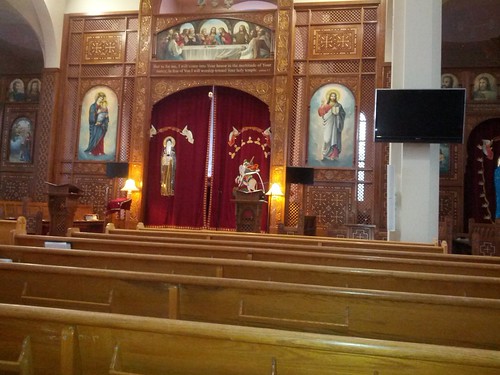
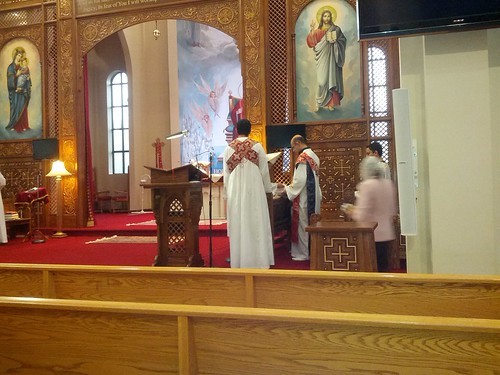
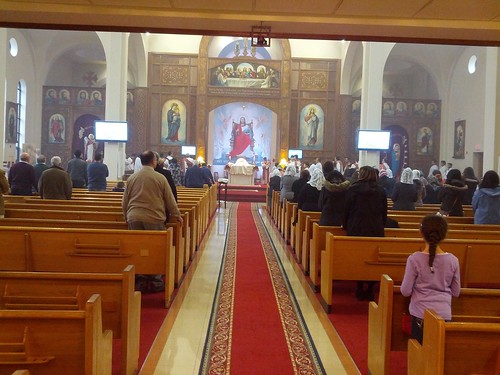
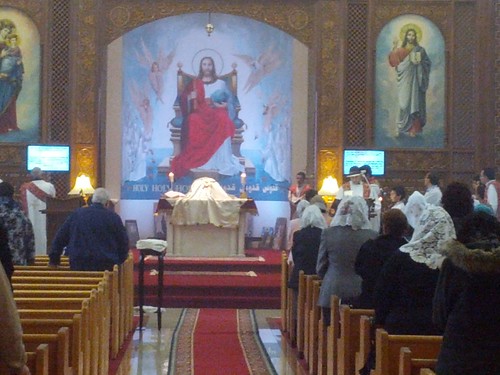
Some personal impressions:
- I didn't quite know what to expect when I arrived. The uncertainty of the unknown at times invites a bit of 'fear' ( of 'acceptance', or 'faux pas'). I forgot to ask in advance, for instance, if there were instructions for the dressing costumes, particularly for visiting women of the group. Luckily they had scarfs that served as veil.
- The liturgy is filled with visuals. From the images to the symbols to gestures, it was beautiful to see how rich they were. (In contrast with the Reformed branches of Christianity, many of which removed the symbols as they collided with the alleged 'idolatry' of Roman Catholicism).
- Historically, Reformed churches tried to remove the 'special status' of clergy and laity. In the service at St. George & St. Anthony the Fathers and Deacons were at the front, but looking at the liturgy, the participation of 'clergy' in Reformed churches is not much different in general than what I witnessed.
- Clergy and Deacons at the altar were all male. There might have been about 80 people in the congregation, with a good mix of all ages. A large room with glass allows parents with small children to follow the service.
- I didn't quite know what to expect during the service. I did notice that there was lots of reading of Scripture ( Hebrew Bible and New Testament ). Readings of the liturgy were documented in a book available at the pews and also projected on screens. These readings had the text in Greek, Arabic and English. Readings of Scripture were in Arabic and English.
- The sermon spoke about the Parable of the Sower, which was the reading of the Gospels. To me it sounded clear. I liked it. (It seemed easier to understand and accept what I was hearing, as if I didn't have much 'filters' in my ears for being of a Christian background... ) The Father spoke, among other things, that there were conversations about what it meant for a church to be 'of Jesus Christ'. And that he thinks a church must be 'evangelical' and 'missionary' (in the context of the Parable). Very nice.
- The Father gave us a book and a few booklets about their tradition. The booklets are addressed to youth.
Tuesday, September 25, 2012
Palavras Bravas - Sermão proferido na Igreja Menonita de Ottawa
Palavras Bravas - Gustavo Frederico
Sermão proferido na Igreja Menonita de Ottawa em 12 de Agosto de 2012
Como leigo, é uma oportunidade rara eu pregar. Eu preguei por alguns meses na minha igreja anterior em Vanier, uma igreja Batista, durante o período em que não tinha pastor. O melhor conselho homilético que eu já ouvi veio de um pastor da África do Sul que me disse uma vez que o que um pastor diz em até 10 minutos vem de Deus. De 10 a 15 minutos vem dele ou dela mesmo. Depois de 15 minutos vem do Diabo.
Um teólogo brasileiro, Valdir Steuernagel, disse uma vez que teologia é pessoal. Que a história do teólogo está por trás do seu fazer-teologia. Estou aqui dando uma palinha de mim mesmo, por assim dizer, enquanto tento falar algo sobre este mistério do além.
Uma das características do Anabatismo que eu admiro é a sua ênfase na resolução de conflitos. A brabeza, ao meu ver, implica em tensão ou desentendimento. Várias vezes as palavras bravas precedem ou anunciam alguma ação violenta. Então pode-se perguntar: reagir sem raiva é melhor do que reagir com raiva? Existe “conflito bom”? Eu creio que existe “conflito bom”. Palavras bravas podem ser compreensívels, desejáveis ou necessárias, dependendo do contexto.
Silêncio
Contrastando com a brabeza eu vejo uma outra reação: o silêncio. Existe uma interpretação perigosa de certas passagens bíblicas como se elas sempre prescrevessem o silêncio e a imobilidade. Quando alguém é ofendido, ferido ou desrespeitado, a pessoa pode escolher não reagir. Isto, porém, pode ser uma prescrição para a pessoa viver tormentada por dentro. Ficar em silêncio pode também aprovar os atos ofensivos. A pessoa seria machucada por fora e por dentro. Existem várias passagens que nos induzirão a não ficarmos bravos. Jesus disse “Bem-aventurados os mansos” [Mateus 5:5a, JFA]. E também “Se alguém lhe der um tapa na cara, vire o outro lado para ele bater também” [Mateus 5:39b NTLH] Isaías descreve o Messias: “Ele foi maltratado, mas aguentou tudo humildemente e não disse uma só palavra.” [Isaías 53:7a NTLH] O poeta escreve em Lamentações 3 “Quando Deus nos faz sofrer, devemos ficar sozinhos, pacientes e em silêncio. Quando somos ofendidos, não devemos reagir; mas sim suportar todos os insultos.” [ Lamentações 3:28,30 NTLH] Mas pensemos: o autor de Lamentações escreve 5 poemas e orações e diz para ficarmos sofrendo em silêncio? Se nós lermos um pouco mais à frente no mesmo capítulo o autor já está orando com raiva: “Ó Senhor, dá-lhes o que merecem, castiga-os pelo que têm feito. Amaldiçoa-os e faze com que eles caiam no desespero. Persegue-os na tua ira, ó Senhor, e acaba com eles aqui na terra!” [ Lamentações 3:64-66 NTLH]
Jesus Bravo
Ao olharmos também para Jesus não devemos apenas preconceber um simples Jesus “gentil” que disse “bem-aventurados os mansos”. Também devemos aceitar um Jesus bravo que chama Herodes de raposa, o que aparentemente era um grande insulto. Nós também devemos nos lembrar do Jesus bravo que chamou aos líderes religiosos do seu tempo de “guias cegos”, “tolos e cegos”, “hipócritas”, e “cobras venenosas, ninhada de cobras!”. Você acha que eles se sentiram ofendidos? Você tem algum problema com esse Jesus? Nós devemos também aceitar um Jesus irado expulsando mercadores e consumidores do templo [ Mateus 11:12,13 ]. Dr. Walter Wink explica que “dar a outra face” naquele contexto cultural pode ser algo diferente do que muitos pensam. Naquela época, um senhor repreendia um escravo com um tapa com a mão direita na sua face direita. Se a pessoa ofendida oferecesse o lado esquerdo do rosto, o agressor precisaria bater na pessoa não como senhor, mas como semelhante. Seria um ato de identificação do abuso e exposição do mesmo como tal, sem escalar a violência.
Quado eu era criança, meu tio, que é pastor Batista no Brasil, me falou uma vez sobre um cristão. Meu tio descreveu como este irmão era manso. Disse que nunca ninguém ouviu falar nada mau vindo dele nenhuma vez. Uma vez, contudo, quando alguém “pisou no seu calo”, ele disse “Seu bobo!” E ele imediatamente sentiu muita culpa com sua explosão de raiva e depois orou a Deus pedindo perdão. Eu não conheci esse homem, mas penso que esses tipos de sentimentos precisam sair do peito para nosso próprio bem-estar. A inércia pode ser uma tentativa de suprimir sentimentos. E isso não é bom. Nós não devemos simplesmente assumir a “inércia” como virtude moral.
Eu valorizo os momentos quando a realidade bate à nossa porta e vemos as coisas mais claramente. Somos confrontados pela realidade de falha, dor, sofrimento e injustiça. Há algo bom quando há espaço para que nossas expressões de condição humana brotem. Eu gosto desse tipo de oração: a respiração da condição humana.
Graça e Condição Humana
Vendo de uma forma, pode não haver problema na igreja em geral convidar pecadores ao arrependimento e a buscar viver ‘padrões mais elevados de moralidade’. Eu creio, contudo, que existe um problema comum que merece um pouco de cuidado. Quando tal convite para ‘padrões mais elevados de moralidade’ vira uma prescrição para noções preconcebidas de comportamento que fazem a pessoa virar uma espécie de super-herói espiritual, nós tendemos a esconder os aspectos não tão bonitos de nossa condição humana. Em outras palavras, se a igreja só mostrar ‘bom comportamento’, ela não abrirá espaço para que nossas imperfeições apareçam. É melhor que nossas imperfeições apareçam ou devemos escondê-las? Peter Rollins escreveu sobre isso desta maneira: “Qual é a alternativa para tentar manter princípios éticos? A resposta é criar espaços de graça nos quais sejamos convidados a trazer nossas trevas à luz, a falar delas em um ambiente no qual não seremos condenados ou culpados. Uma comunidade que nos deixará falar nossas ansiedades e trevas sem pedir que mudemos. Em suma, um lugar onde nós poderemos confrontar nossa humanidade ao invés de fugir dela”.
Existe um problema inerente quando noções de “espiritual” e “do mundo” ou “sagrado” e “secular” são postas em tensão umas contra as outras. Se ser mais espiritual significar ser menos humano, mostras de humanidade certamente rotularão a pessoa como não-tão-espiritual.
Deus Acontece Dentro da Vida Humana
Em 2010, como alguns de vocês sabem, eu e minha família passamos o ano no Brasil. Eu conheci algumas famílias que moravam perto de um lixão e que trabalhavam reciclando. Elas foram removidas à força para o meio do nada pelo governo em um esquema de corrupção com subsídio do Banco Mundial. Joaquim foi um jovem removido junto com sua família. Eles eram membros de uma igreja evangélica de uma denominação grande. Quando Joaquim e outros notaram que nada aconteceria, decidiram fazer algo. Formaram uma pequena associação de bairro. Tentaram falar com políticos locais. Eles tentaram contactar a imprensa local. Acharam um advogado pro bono. Eles até mesmo escreveram um email em Inglês para os burocratas mais altos do Banco Mundial. Por alguma razão, a igreja local não gostou do que o Joaquim fez. Ele foi disciplinado, sendo suspenso do seu papel de líder na igreja e sua família ficou proibida de tomar a santa ceia. Eventualmente ele e sua família foram convidados a se retirarem da igreja. Disseram a ele que estava confiando na justiça dos homens e não na justiça de Deus.
Deus está no controle da História, nós estamos no controle da História ou é tudo aleatório? Se nós simplesmente dissermos que “Deus está no controle da História”, será difícil de entender como permite tanto sofrimento. Se nós simplesmente dissermos que “nós estamos no controle da História” ou que é tudo aleatório, podemos dar a entender que Deus não age e renunciaríamos a esperança e o sentido. O teólogo brasileiro Leonardo Boff escreveu sobre Bultmann e seus discípulos: "Depois de Kant [...] devemos terminantemente excluir qualquer objetivação de Deus, mesmo a denominação de espírito e pessoa. Deus não é objeto de conhecimento nem existe simplesmente como existem as demais realidades. Ele acontece dentro da vida humana. Ele é aquele acontecimento que permite surgir o amor e no qual o mau e o desesperado recebem esperança e futuro. [...] Deus continua a desempenhar uma função: ele é o símbolo para o comportamento que Cristo exigiu de todos: irrestrito amor e obediência desinteressada aos apelos de reciprocidade ilimitada. Onde quer que se dê isso, lá está Deus presente" [“Jesus Cristo Libertador”, L. Boff, p.210] O teólogo latinoamericano Juan Luis Segundo escreveu: “Se cada palavra de Deus não se referir a uma experiência humana, ela se torna como uma mensagem escrita em uma linguagem desconhecida” [“A Libertação da Teologia”, Juan Luis Segundo]
Eu particularmente fico bravo quando alguém explica a injustiça como sendo algo natural. Especialmente quando o desfavorecido e o pobre são condenados a sofrer por serem quem são. O homem que criou a política do FMI do Brasil nos anos 60 se chamava Roberto Campos. Para justificar a política na qual empresas brasileiras tinham que pagar taxas de juros 7 vezes maiores que empresas estrangeiras, ele disse: “Obviamente, o mundo é desigual. Há quem nasça inteligente e há quem nasça tolo. Há quem nasça atleta e há quem nasça aleijado. O mundo se compõe de pequenas e grandes empresas. Uns morrem cedo, na plenitude da vida; outros se arrastam, criminosamente, numa longa existência inútil. Há uma desigualdade básica fundamental na natureza humana, na condição das coisas. Disto não escapa o mecanismo do crédito.” [Roberto Carlos, CPI da Câmara de Deputados, 6/9/1968] Em outras palavras, o destino de alguns é sofrer para alimentar a ganância de outros poucos extremamente ricos e isto está escrito nas estrelas. Nos círculos religiosos, palavras que espiritualizam relações humanas injustas ou palavras que recorrem a Deus para estigmatizar os “mais humildes dos meus irmãos” são especialmente perigosas. Um dos pastores brasileiros mais famosos, Silas Malafaia, por exemplo, disse que a pobreza é o resultado da disobediência às leis de Deus.
Se Deus acontece dentro da vida humana, orações são conversas com esta vida e seus contextos. Se Deus acontece dentro da vida humana, a História é sagrada. Especialmente as versões relatadas pelos “mais humildes dos meus irmãos”. Eu costumo prestar mais atenção à consciência que atribui a Deus e a nós mesmos ao mesmo tempo a responsabilidade do nosso destino. Com palavras de raiva é mais fácil pegar Deus pra bode expiatório do que assumir a responsabilidade individual e coletiva por nossas ações ou falta de ações.
A Bíblia em Uma Mão, o Jornal na Outra
O cerco de Jerusalém em 587 A.C. pelos Babilônios contém imagens muito violentas. Quando leio Lamentações relaciono-as a algumas histórias brasileiras. Algumas delas talvez sejam violentas demais para descrever aqui. Uma das leituras que chama a minha atenção nesses textos é que eles falam não só de sofrimento e palavras bravas a mim, mas eles também aludem a um contexto maior e a como relações entre nações influenciam as vidas de pessoas comuns. Quando leio “temos de comprar a nossa própria água de beber; temos de pagar pela nossa própria lenha”, “para termos o que comer, precisamos de pedir, estendendo as mãos aos egípcios e aos assírios” [Lamentações 5:4,6 NTLH] eu me lembro de alguns amigos meus no Brasil que tem que comprar gás do mercado negro controlado pela polícia. Quando eu leio “Deus sabe quando neste país os prisioneiros são massacrados sem compaixão. O Deus Altíssimo sabe quando são desrespeitados os direitos humanos, que ele mesmo nos deu. Sim, o Senhor sabe quando torcem a justiça num processo” [Lamentações 3.34-36 NTLH] eu me lembro do massacre do Carandiru, onde 111 presidiários foram mortos pela polícia em um dia em 1992. Os líderes religiosos de Jeremias foram culpados de convocarem as pessoas a resistirem aos Babilônios e isto resultou em mais mortes. Eles perseguiram Jeremias e tentaram matá-lo fazendo lobby com o rei. Lemos em Lamentações 4:13: “Tudo isso aconteceu por causa dos pecados e das maldades dos seus profetas e dos seus sacerdotes, culpados de causar a morte de pessoas inocentes”. Minhas palavras bravas não são relacionadas a perseguição pessoal, mas elas falam contra os deputados evangélicos no Congresso Nacional, que recentemente votaram contra o Projeto de Emenda Constitucional que confiscava terras com trabalho escravo.
Os poemas em Lamentações não tentam explicar, nem justificar, nem ajudar a entender o sofrimento. Ao invés, eles mostram conversas com Deus que olham para a realidade e lutam sinceramente com o divino. Nós só choramos porque existe esperança que alguém ouça.

Este sermão está licenciado sob a Atribuição-NãoComercial-SemDerivados 2.5 Brasil da Creative Commons.
Você tem a liberdade de:
- Compartilhar — copiar, distribuir e transmitir a obra.
Sob as seguintes condições:
- Atribuição — Você deve creditar a obra da forma especificada pelo autor ou licenciante (mas não de maneira que sugira que estes concedem qualquer aval a você ou ao seu uso da obra).
- Uso não comercial — Você não pode usar esta obra para fins comerciais.
- Vedada a criação de obras derivadas — Você não pode alterar, transformar ou criar em cima desta obra.
Ficando claro que:
- Renúncia — Qualquer das condições acima pode ser renunciada se você obtiver permissão do titular dos direitos autorais.
- Domínio Público — Onde a obra ou qualquer de seus elementos estiver em domínio público sob o direito aplicável, esta condição não é, de maneira alguma, afetada pela licença.
- Outros Direitos — Os seguintes direitos não são, de maneira alguma, afetados pela licença:
- Limitações e exceções aos direitos autorais ou quaisquer usos livres aplicáveis;
- Os direitos morais do autor;
- Direitos que outras pessoas podem ter sobre a obra ou sobre a utilização da obra, tais comodireitos de imagem ou privacidade.
- Aviso — Para qualquer reutilização ou distribuição, você deve deixar claro a terceiros os termos da licença a que se encontra submetida esta obra. A melhor maneira de fazer isso é com um link para esta página.
Sunday, June 05, 2011
Bad theatre for children
Today we went to see "At Nightfall" at the Ottawa International Children's Festival. Now that's bad theatre. Nothing happens in the story. It's pure non-sense. I couldn't stand it anymore and we left after 20 minutes. I want my money back but I guess it's in the fine print somewhere that I can't have it. Anyways, whoever wrote this thing, geez, couldn't you write something where there's action and stuff happening? Whoever approved this piece is also an accomplice. By the Sursaut Dance Company, Serbrooke, Quebec.
Wednesday, June 10, 2009
There is a church
There is a church in Ottawa
that preaches the Gospel
where people care for each other
that is mindful of the state of the world and is truly preocupied with it
that practices their faith
that has a sense of community
that encourages participation of all
that feels empathy for those who suffer near and far
that cares for the outcast, forgotten and disabled
that takes the Scriptures seriously
that cares for children and treats them with respect
whose members come from all different backgrounds
with members in all diferent stages of life
with members that do missions
with members who express empathy by adopting children
with members who are truly commited to other members
that sings with gladness
that is comptempt with simplicity
that is involved with peace and reconciliation
that does not shy away from difficult subjects
That church is called the Ottawa Mennonite Church.
that preaches the Gospel
where people care for each other
that is mindful of the state of the world and is truly preocupied with it
that practices their faith
that has a sense of community
that encourages participation of all
that feels empathy for those who suffer near and far
that cares for the outcast, forgotten and disabled
that takes the Scriptures seriously
that cares for children and treats them with respect
whose members come from all different backgrounds
with members in all diferent stages of life
with members that do missions
with members who express empathy by adopting children
with members who are truly commited to other members
that sings with gladness
that is comptempt with simplicity
that is involved with peace and reconciliation
that does not shy away from difficult subjects
That church is called the Ottawa Mennonite Church.
Tuesday, March 03, 2009
Tuesday, January 06, 2009
'The Gift' of Father Suarez
http://www.canada.com/ottawacitizen/features/faithandethics/story.html?id=e809589a-b6b4-4e3e-a8b1-df4e6f47bb2e
From the Ottawa Citizen, 2008
From the Ottawa Citizen, 2008
'The doors opened at noon for the 2:30 p.m. mass, and by 12:15, the pews were jammed. People kept pouring in anyway, filling the aisles. In the church basement, several hundred more sat before a television screen, awaiting the mass. Ushers tried to turn people away, despite the pleas: "My mother is in a wheelchair, please let us in." Father Suarez promised to bless them all, but they would have to wait six more hours.
Inside the church, the pastor, Father Bill Halbing, shouted like a DJ: "Let's get rockin' in the Spirit, because this is a day of healing! You will see signs and wonders today!"
After mass, people scrambled forward to have Father Suarez lay his hands on them, pushing and stumbling so much that his assistant, Father Jeff Shannon, had to appeal for good manners and forgiveness for queue-jumpers. Silently, Father Suarez put his hand on each forehead, shoulder, or neck, sometimes even tweaking a nose while Father Shannon kept up an encouraging patter: "Love, love, love! Happy, happy, happy!"Some were so overcome they swooned to the floor. Others came forward to attest to their newfound health. Arthritis vanished, headaches eased, hearing suddenly became clear, no questions asked. Only the worst killjoy would douse with doubt the sense of joy and celebration.'
--
I was thinking the other day about tensions in relationships. One of the things that one professional Christian psychologist said was that we need to let our masks down. I began to think about what leads us to put the masks in the first place.
I suspect of images that are sold to us of happiness. Along with Father Shannon saying "Love, love, love! Happy, happy, happy!", there are many ads and tv shows repeating the mantra. Who doesn't want more happiness and love? Still, we shouldn't be naïve, living in la la land.
It appears that some of the happiest people on earth live in countries of Buddhist majority. Ok, Buddhism, as I was told, encourages people to change the reality in their minds, that is, their perception of reality. They find happiness in some other realm. People who became Christians in the pursuit of happiness may consider changing their religion.
And what to say of Nordic countries? Apparently, a larger percentage of the population there enjoy life better than in the US. The Nordic countries, as I was told, have some of the highest percentages of atheists too. Does that mean that to find contentment in life, Christians should consider becoming atheists?
Christians should be well equipped to perceive reality. And let them (/us) not foul themselves that the purpose of this religion is happiness or self-contentment. Perhaps it's time for them (/us) to read the Gospels.
Friday, August 01, 2008
Cracked display, FutureShop's warranty

This is my father's Acer notebook. We bought it at FUTURESHOP here in Ottawa. As you can see it has a cracked display. We bought the 'extra-super-duper-extended-valid-all-over-the-world' warranty, so that if it broke in Brazil my father could fix it there under the warranty. The display cracked alone, likely wiggling in the passenger's seat of my father's car. 100% sure it didn't fall. I managed to bring the notebook to Canada to get it fixed. But the warranty didn't cover it. That's right, it was considered 'abuse', even though I explained it wasn't abuse, that it happened all of a sudden with normal use. It's in the fine print. I get angry because it's not abuse but they use the word anyways. Why not call it accident? They would charge me $400 to get it fixed (and a new notebook was $499). I now use it anyways with the cracked display. I may get a flat panel monitor one day to use with it.
Conclusion: 1- I'll never buy extra warranties at FutureShop because they are bad. 2-Notebook displays crack easily.
Friday, June 20, 2008
Living in a house
The nice and not-so-nice things about living in a house (in Canada):


"Hey, what are you looking at ?!"


"Hey, what are you looking at ?!"
Monday, April 21, 2008
Bad service in restaurants in Orléans
We went twice to Swiss Chalet in Orléans, ON (@ Innes Road). Both times waiting times were high. That is, time waiting to place the order, time waiting for the food and so on. Imagine that with two small children. We're not coming back.

We also waited for long minutes at Boston Pizza in Orleans, ON, (@ Innes Road too) to be served on a regular Sunday.


Both waiting times were long, but Swiss Chalet won the prize of the worst one.

We also waited for long minutes at Boston Pizza in Orleans, ON, (@ Innes Road too) to be served on a regular Sunday.


Both waiting times were long, but Swiss Chalet won the prize of the worst one.
Tuesday, April 01, 2008
We must never forget the commandment to welcome the stranger
Janice Kennedy, The Ottawa Citizen
Published: Sunday, March 30, 2008
This Thursday, Ottawans will gather at a banquet hall to eat, dance, participate in a silent auction and generally contribute to yet another fundraiser for yet another worthy cause. This Thursday is also Refugee Rights Day, the anniversary of a Supreme Court ruling 23 years ago that refugee claimants’ rights to life, liberty and security of the person are protected by our Charter of Rights and Freedoms. The two events are not unrelated. The fundraiser is for a remarkable little Ottawa group called Helping With Furniture (helpingwithfurniture.com), founded less than three years ago by friends Buffey Cassidy and Nathalie Maione. HWF picks up used furniture and household goods from people who might otherwise have to leave them for the landfills, and then delivers the goods to refugee families who have, almost literally, nothing.
Cassidy still recalls the scene that greeted her a couple of years ago when furniture landed on the doorstep of a family from El Salvador. Mother, father and three young children had been living for two full months with nothing — nothing — but blankets on the floor. No table, no chairs, no mattresses.
Forty-five minutes later, HWF had set up a household for them. Cassidy remembers one of the little boys shyly taking her hand, and then the whole family holding hands with the volunteers. She remembers the father’s prayer in Spanish, the way he told God he thought they’d been abandoned, but now they had hope.
Cassidy, 39, and Maione, 46, are busy women, both of them operators of home-based daycares. So there must be a pretty good reason for the endless volunteer hours they put in, the heavy lifting they do, the out-of-pocket money they freely spend. And there is.
The women saw a problem and knew they could do some small thing about it. (The organization, which receives no grants and is only now getting charitable status — having relied exclusively on donations and goodwill — has helped more than 140 families in its brief history.) They also knew they could coax a sliver of hope into hopeless lives.
Cassidy is originally from a Nova Scotia fishing village, and Maione emigrated with her family from France as a child. Although neither suffered the deprivations of desperate refugees, both understand firsthand the unsettling reality of being a stranger in a strange place.
That kind of empathic understanding is really what it’s all about, in the end.
Refugees, and immigrants generally, challenge our collective conscience.
We harbour attitudes among us that are often closed and suspicious, fit-in-or-go-home mentalities. We’re confronted by some people’s curiously entrenched beliefs that immigration here should have stopped with the French, or the Scots, English and Irish, or the Chinese railway labourers, or the Calabrians, or the postwar refugees from eastern Europe — or any of countless communities of choice and identity.
(To such folks, might I offer a simpler approach? Let go of the anger, embrace the diversity and cherish the new social wealth that has come to us with broader immigration. Far less stressful.)
But of course, there’s more to the issue than attitude, surly or sunny.
Many Canadians justifiably worry about a disruption of the delicate national balance, economically, culturally, socially, politically. Many Canadians — sometimes even the same ones — also worry about how best to do the right thing. The stability of the nation must be safeguarded as much as its moral responsibility in a global community. What to do?
While there is no single answer to an issue involving so many complex spheres of national life, there is a single principle at its core, one that should guide all of us, whether we’re politicians and bureaucrats making life-anddeath decisions, or neighbours in a community.
That principle — and, really, it’s a kind of collective heartbeat — dictates simply that, yes, we are our brothers’ and sisters’ keepers. And we are for the most basic of reasons: because we are indeed all brothers and sisters. Because we look after others as we hope to be looked after ourselves. Because no matter how different our temperaments or how much we squabble, we are all family.
The way Canada treats its immigrants and refugee claimants is far from shameful. We do many things right, including legally recognizing these battered people’s fundamental human rights under our own Charter, a recognition we honour this Thursday. But we have a distance to go, a fact made evident by even a cursory visit to the website of the Canadian Council for Refugees (ccrweb.ca). Among other things, refugee claimants here are still being denied the right of appeal, and victims of human trafficking are not adequately protected by our legislation.
Those are large and important issues. But there are smaller important issues, too, and these are the ones that grassroots groups like Cassidy and Maione’s have set about addressing. Sometimes a single flickering image is all it takes to light a fire.
When you’re shaping your opinion of Canada’s evolving immigration and refugee policy, try picturing a young family. Imagine the five of them gathered in the sudden warmth of a home furnished with beds, chairs and delicate new promise. That’s the heartbeat. That is Cassidy and Maione’s approach.
“We always try to welcome them as neighbours,” says Cassidy.
In a world of complex government policy, solutions don’t come much simpler than that. Or more hopeful.
Janice Kennedy’s column appears weekly. E-mail: 4janicekennedy@gmail.com
Published: Sunday, March 30, 2008
This Thursday, Ottawans will gather at a banquet hall to eat, dance, participate in a silent auction and generally contribute to yet another fundraiser for yet another worthy cause. This Thursday is also Refugee Rights Day, the anniversary of a Supreme Court ruling 23 years ago that refugee claimants’ rights to life, liberty and security of the person are protected by our Charter of Rights and Freedoms. The two events are not unrelated. The fundraiser is for a remarkable little Ottawa group called Helping With Furniture (helpingwithfurniture.com), founded less than three years ago by friends Buffey Cassidy and Nathalie Maione. HWF picks up used furniture and household goods from people who might otherwise have to leave them for the landfills, and then delivers the goods to refugee families who have, almost literally, nothing.
Cassidy still recalls the scene that greeted her a couple of years ago when furniture landed on the doorstep of a family from El Salvador. Mother, father and three young children had been living for two full months with nothing — nothing — but blankets on the floor. No table, no chairs, no mattresses.
Forty-five minutes later, HWF had set up a household for them. Cassidy remembers one of the little boys shyly taking her hand, and then the whole family holding hands with the volunteers. She remembers the father’s prayer in Spanish, the way he told God he thought they’d been abandoned, but now they had hope.
Cassidy, 39, and Maione, 46, are busy women, both of them operators of home-based daycares. So there must be a pretty good reason for the endless volunteer hours they put in, the heavy lifting they do, the out-of-pocket money they freely spend. And there is.
The women saw a problem and knew they could do some small thing about it. (The organization, which receives no grants and is only now getting charitable status — having relied exclusively on donations and goodwill — has helped more than 140 families in its brief history.) They also knew they could coax a sliver of hope into hopeless lives.
Cassidy is originally from a Nova Scotia fishing village, and Maione emigrated with her family from France as a child. Although neither suffered the deprivations of desperate refugees, both understand firsthand the unsettling reality of being a stranger in a strange place.
That kind of empathic understanding is really what it’s all about, in the end.
Refugees, and immigrants generally, challenge our collective conscience.
We harbour attitudes among us that are often closed and suspicious, fit-in-or-go-home mentalities. We’re confronted by some people’s curiously entrenched beliefs that immigration here should have stopped with the French, or the Scots, English and Irish, or the Chinese railway labourers, or the Calabrians, or the postwar refugees from eastern Europe — or any of countless communities of choice and identity.
(To such folks, might I offer a simpler approach? Let go of the anger, embrace the diversity and cherish the new social wealth that has come to us with broader immigration. Far less stressful.)
But of course, there’s more to the issue than attitude, surly or sunny.
Many Canadians justifiably worry about a disruption of the delicate national balance, economically, culturally, socially, politically. Many Canadians — sometimes even the same ones — also worry about how best to do the right thing. The stability of the nation must be safeguarded as much as its moral responsibility in a global community. What to do?
While there is no single answer to an issue involving so many complex spheres of national life, there is a single principle at its core, one that should guide all of us, whether we’re politicians and bureaucrats making life-anddeath decisions, or neighbours in a community.
That principle — and, really, it’s a kind of collective heartbeat — dictates simply that, yes, we are our brothers’ and sisters’ keepers. And we are for the most basic of reasons: because we are indeed all brothers and sisters. Because we look after others as we hope to be looked after ourselves. Because no matter how different our temperaments or how much we squabble, we are all family.
The way Canada treats its immigrants and refugee claimants is far from shameful. We do many things right, including legally recognizing these battered people’s fundamental human rights under our own Charter, a recognition we honour this Thursday. But we have a distance to go, a fact made evident by even a cursory visit to the website of the Canadian Council for Refugees (ccrweb.ca). Among other things, refugee claimants here are still being denied the right of appeal, and victims of human trafficking are not adequately protected by our legislation.
Those are large and important issues. But there are smaller important issues, too, and these are the ones that grassroots groups like Cassidy and Maione’s have set about addressing. Sometimes a single flickering image is all it takes to light a fire.
When you’re shaping your opinion of Canada’s evolving immigration and refugee policy, try picturing a young family. Imagine the five of them gathered in the sudden warmth of a home furnished with beds, chairs and delicate new promise. That’s the heartbeat. That is Cassidy and Maione’s approach.
“We always try to welcome them as neighbours,” says Cassidy.
In a world of complex government policy, solutions don’t come much simpler than that. Or more hopeful.
Janice Kennedy’s column appears weekly. E-mail: 4janicekennedy@gmail.com
Sunday, March 30, 2008
Winter in Canada (photos)
Some photos of this winter in Canada from CBC.ca. / Fotos deste inverno no Canadá do site CBC.ca.

Shovelling was a communal affair on this Montreal street following the weekend storm. (Submitted to CBCNews.ca by Michael Vesia)

A stop sign in Ottawa is buried by snow on March 9. (submitted to CBCnews.ca by Jan Rourke)
( I live in Ottawa ! )

Neighbours in Ottawa helped each other clear the heavy snow on March 9. (Submitted to CBCNews.ca by Justin Van Leeuwen)
( Yes indeed )

Ice coats a chilly Yellowknife on Feb. 2. (Submitted to CBCNews.ca by Linda Dufour)

Ray Seed of Orleans, Ont., was up early, at 6:30 a.m., on March 8 starting the almost futile job of digging out as the storm moved into eastern Ontario. (Submitted to CBCNews.ca by Ray Seed)
( Orleans is my neighbourhood here in Ottawa !)

Shovelling was a communal affair on this Montreal street following the weekend storm. (Submitted to CBCNews.ca by Michael Vesia)

A stop sign in Ottawa is buried by snow on March 9. (submitted to CBCnews.ca by Jan Rourke)
( I live in Ottawa ! )

Neighbours in Ottawa helped each other clear the heavy snow on March 9. (Submitted to CBCNews.ca by Justin Van Leeuwen)
( Yes indeed )

Ice coats a chilly Yellowknife on Feb. 2. (Submitted to CBCNews.ca by Linda Dufour)

Ray Seed of Orleans, Ont., was up early, at 6:30 a.m., on March 8 starting the almost futile job of digging out as the storm moved into eastern Ontario. (Submitted to CBCNews.ca by Ray Seed)
( Orleans is my neighbourhood here in Ottawa !)
Saturday, March 08, 2008
Snow / neve
We're getting lots of snow this year here in Ottawa / Estamos pegando muita neve esse ano em Ottawa.
The entrance of our house / a entrada de casa:

The view on the side of the house / a vista do lado da casa:

The backyard (you can almost see the top of the basketball table buried in snow) / o quintal de trás (quase dá pra ver a parte de cima da tabela de basquete enterrada na neve) :

The entrance of our house / a entrada de casa:

The view on the side of the house / a vista do lado da casa:

The backyard (you can almost see the top of the basketball table buried in snow) / o quintal de trás (quase dá pra ver a parte de cima da tabela de basquete enterrada na neve) :

Tuesday, December 25, 2007
Saturday, December 22, 2007
Tuesday, December 11, 2007
Lounge Night - Ottawa Baptist Association - Youth

Ontem teve aqui o Lounge Night, promovido pelos Jovens da Associação de Igrejas Batistas de Ottawa. Foi muito bom. A líder de jovens da igreja organizou. Alugamos um lounge (tipo um bar). Um DJ da rádio cristã veio pôr músicas e ser o MC. Tivemos um mini-concurso de bandas locais. A banda vencedora ganhou uma música a ser produzida em estúdio. E outros músicos se apresentaram.
O bar fica no setor de badalação da cidade, do lado do centro (no Market).
Gostei muito do ambiente. Era pequeno, tinha dois andares. Tinha luz fraca, outras luzes coloridas e um globo espelhado no teto. A banda ganhadora era de uma escola (a maioria dos integrantes eram não-crentes. Conversei com alguns pais dos integrantes.). Da nossa igreja (nossa igreja é bem pequena, tem uns 30 membros) foram vários jovens. Dois participaram do concurso. O Nilton matou a pau com o seu rap. Ele tem gravado em Montreal. Ele me disse que a escola dele (pública) tem um estúdio. Ele pode usar o quanto quiser de graça (coisas de Canadá...). Depois de gravar na escola ele leva as gravações pra Montreal pra ficar mais
profissional. O pessoal da rádio gostou tanto que vai pôr uns raps dele no ar.
O pessoal dançou muito ao som de hip-hop e dance. Dá pra ver que não somos Batistas americanos... Quem sabe da próxima vez não abrimos o bar com umas caninhas?
Foi um lugar neutro onde crentes e não-crentes podem se encontrar, se
divertir e interagir. Foram muitos jovens que eu conheço (amigo do amigo) que não poriam o pé numa igreja. Fica a idéia.
Subscribe to:
Posts (Atom)