FB_init

Tuesday, November 05, 2013

Petição por Ricardo Esquívia, Colômbia


A Asociación Sembrando Semillas de Paz (Sembrandopaz) emite uma AÇÃO URGENTE para a segurança física e jurídica e direito à boa reputação e a um processo justo de Ricardo Esquívia Ballestas, diretor desta organização, assim como de outros líderes do processo comunitário da Zona da Montanha Alta de El Carmen de Bolívar, Colômbia.

Ações recomendadas
§  Manter Ricardo Esquívia, os membros da equipe da Sembrandopaz e os líderes da Zona da Montanha Alta de El Carmen de Bolívar em oração.
§  Espalhar amplamente esta Ação Urgente.
§  Solicitar ao Estado da Colômbia (veja as instruções aqui) para se pronunciar sobre este problema e tomar todas as medidas cabíveis para assegurar o respeito à vida, integridade física, direito a um processo justo e boa reputação de Ricardo Esquívia, dos membros da equipe da Sembrandopaz e dos líderes da Zona da Montanha Alta de El Carmen de Bolívar.
§  Solicitar ao Estado colombiano que se pronuncie sobre esta questão e apoiar a participação social e total implementação da Lei de Restituições de Terras e Vítimas e rejeitar todas as ações contra este processo.
§  À comunidade internacional, comunicar-se com seus representantes públicos e com a embaixada colombiana em seu país para manifestar preocupação e solicitar apoio para esta ação urgente.
§  Solicitar ao Estado colombiano a garantia dos direitos a um processo justo e à integridade física de Jorge Montes no seu local de prisão para que ele não seja sujeitado à tortura e maus tratos.

Leis e antecedentes
Fontes confiáveis confirmaram uma ameaça iminente por autoridades colombianas contra a liberdade de Ricardo Esquívia Ballestas e de membros do comitê de coordenação do Movimento da Zona de Alta Montanha de El Carmen de Bolívar e contra a legitimidade da Asociación Sembrando Semillas de Paz (Sembrandopaz).
A Sembrandopaz foi fundada sob a liderança de Ricardo Esquívia Ballestas em 2005 com o apoio e patrocínio da Igreja Menonita da Colômbia com o objetivo de acompanhar processos comunitários de justiça e de paz no Montes de María e região caribenha da Colômbia.  A Sembrandopaz é uma expressão ativa dos valores da não-violência, da solidariedade e do amor ao próximo, com os quais a Igreja Menonita mundial está comprometida desde seu início do século XVI.  Desde a sua formação inicial na Igreja Menonita, Ricardo Esquívia tem acompanhado os processos de construção da paz, da dignidade humana e da conciliação, ao lado de igrejas e comunidades locais na região dos Montes de María por aproximadamente 40 anos.
Há um ano, a Sembrandopaz iniciou o acompanhamento do movimento da Zona de Alta Montanha de El Carmen de Bolívar, cujas comunidades organizadas pelos seus direitos a indenizações integrais e transformadoras, um retorno digno à sua terra, garantias de não repetição e apoio do estado para a solução das morte das culturas de abacate em mais de 40 comunidades rurais da região de Montes de María.
O movimento comunitário da Zona de Alta Montanha fez uma marcha pela paz de 5 a 8 abril de 2013 para exigir um diálogo com as autoridades locais, estaduais e nacionais, que começou em San Jacinto em 7 de abril e continua até o momento.  O movimento tem contribuído para promover a conciliação entre as comunidades antes divididas e fracionadas da Zona Alta Montanha e para incentivar a participação dos cidadãos no diálogo.
Em 3 de setembro deste ano [2013], apareceram folhetos na Zona de Alta Montanha em toda as comunidades de Macayepo e Lazaro, ameaçando vários líderes do movimento, incluindo o coordenador do movimento, Jorge Luis Montes Hernández.  Esse documento acusa os líderes de roubo, extorsão e associação com as FARC-EP e é assinado por um grupo paramilitar de autodefesa, "Los Urabeños" e BACRIM.
Em 9 de setembro [de 20213], o promotor de El Carmen de Bolívar convocou o líder comunitário, Jorge Montes, para se apresentar em seu escritório e lá o prendeu por meio de um mandado.  Na audiência pré-julgamento, em 11 de setembro, o Sr. Jorge Montes foi acusado dos crimes de pertencer à 35ª Frente das FARC-EP, formação de quadrilha, homicídio, deslocamento forçado, extorsão e outros.
Segundo fontes fidedignas, as ameaças contra Ricardo são semelhantes às ações e processos iniciados contra ele por autoridades colombianas em 1989, 1993 e 2004, com base em falsas acusações que foram posteriormente suspensas por falta de fundamento.
No final do mês de junho deste ano, após o acompanhamento da Sembrandopaz na Marcha pela Paz da Zona de Alta Montanha, dois membros internacionais da equipe da Sembrandopaz com vistos religiosos temporários para apoiar a Igreja Menonita da Colômbia, Anna Vogt do Canadá e Lariza Zehr dos Estados Unidos, foram convocados ao escritório de Relações Exteriores da Colômbia para verificar a validade da sua situação migratória, com a possibilidade de deportação.  Este processo ainda não foi resolvido.
Assine a petição para interromper a perseguição política de Ricardo Esquívia e trabalhadores colombianos de direitos humanos. Pare por um momento para escrever uma carta aos representantes do governo colombiano e membros importantes da comunidade internacional.


----

Texto originalmente publicado em Inglês e Espanhol no Blog de Advocacy na América Latina do Comitê Central Canadense Menonita. Ver link aqui.
 

Sunday, September 15, 2013

Liberation Theology

Here is my presentation on Liberation Theology

Liberation Theology
Topics
1. Motivation for Liberation Theology
2. Summary of Theology
3. History

1. Motivation for Liberation Theology
- Hunger, injustices, violence (in Latin America, then in the world)

2. Summary of Theology
- How can those who suffer say God is love?
- Catholics & Protestants
- Emphasis on praxis
- 1st: acting in the world with the poor. Only after comes theological reflexion.
- Two main tools
    - Social Sciences - especially Sociology and Political Sciences ( what about Marxism? Marxism as indirect, embedded theory in Social Sciences in general. According to Gutierrez, no direct application.)
     - Biblical Exegesis  - from the poor

2. Summary of Theology
- Rejection of unjust structures
- Rejection of dualisms / (like body vs spirit).

- New models of life in communities (like the Anabaptists)
Formation of Base Ecclesial Communities
    - Small communities that read the Bible and think about social/political challenges.
     - Brazil: 70,000 BECs / ~ 1.8 million members.
- Main methodology of BECs: see-judge-act  
- BECs: Bad business for churches
- The School of the Americas in the US: “We helped destroy Liberation Theology”  ( did they? )

2. Summary of Theology
- Althaus-Reid
  - Indecent Theology - reconfigures Lib. Theo
  - ‘poor’ / ‘oppressed’ is insufficient: transgender, etc
  - Don’t [patronize, romanticize] the poor
  - Don’t “move” the poor to systematic theology
  - Academics of Lib. Theo. gave in to the capitalism system
  - The need to subvert theology & economy with indecency


2. Summary of Theology
“The crime of liberation theology was that it takes the Gospels seriously. [...] The Gospels are radical pacifist material, if you take a look at them. That was the major crime that set off the Reagan wars of terror.” - N. Chomsky

“When I share the bread with the poor, they call me a saint. When I ask why they are poor, they call me a communist.” - Dom Hélder Câmara

2. Summary of Theology

3. History - Early history, 50s, early 60s
 - Sublimus Dei - bull - 1537 - Pope Paul III - Indians are human beings
 -  Valladolid debate - 1551 - Las Casas vs Sepulveda
  --------
 - 1959 - Cuban Revolution
    - Armed revolution
 - 1961 - Cuba : nationalization lands, including religious institutions
   - “Atheist state” (1976)
 - Vatican II (62) - Not much input from South
 - Conference: “Christ and the Brazilian Revolutionary Process” (62, by Protestants)


3. History - Mid 60s
- Wave of military coups begin (Brazil 64)
- Movement of Priests for the Third World (Arg 67 - 76)
[ - Student protests in France (68) ]
[ - Trudeau becomes PM (68) ]
- Conference of Medellín, Colombia - (68) - Theology by the South
  “Latin America finds itself, in many places, in a situation of injustice which may be called institutionalized violence. Such situation demands global, daring, urgent and profoundly renewing transformations” - Medellín, “On Peace”, ch 16
- Rockefeller, Vice President of USA (68): “If the catholics put in practice what they wrote in Medellín, our interests are in danger”

3. History - 70s
- Gustavo Guitiérrez writes the book “Liberation Theology” (72)
- Conference of Puebla, Mexico - (79) preferential option for the poor
- Wave of military coups
- Escalation of human rights violations in torture and killings (carried out mostly by army, police)
- Lib.Theo. religious people special targets
- Operation Condor - coordination of police & counter-intelligence in South America
    - American $, moved to armies & police of repressive gov

3. History - 70s
- San Patricio Church massacre (76, Argentina) - 5 priests
-  Pope John Paul II commissions then Archbishop Ratzinger, the prefect of the Congregation for the Doctrine of the Faith (aka Inquisition), to study Liberation Theology
   - Criticisms:
        - Too much politics (not spiritual enough)
        - Catholic Church accomplice of privileged class since Conquista (“don’t say that”)
- Deliberate effort by Rome to censor Liberation Theology

3. History - 80s
- Óscar Romero assassinated in El Salvador (80)
- US and Vatican establish diplomatic relations (84)
- Libertatis Nuntius(84) & Libertatis Conscientia (86)
- L. Boff gets imposition of 1 year of silence by Inquisition for his book (85).
 “Jesus did not have in mind the Church as institution” ‘today a “new church” must arise, which will be an alternative for the incarnation of new ecclesial institutions whose power will be pure service’
- 6 scholar Jesuit priests & 4 American nuns assassinated in El Salvador (89)

3. History - 80s
- Liberation theologians -> academia & people
- Liberation practitioners -> social movements
  - birthplace of many ‘new political movements’/’new organizations’
     - non-hierarchical, anti-institution
- Rise of evangelicals (specially Pentecostals)
- Evangelicals courted by governments
- Waves of missionaries from the US
    - Replacing expelled lib. theologians in seminaries
- Pentecostals increase presence in media

3. History - 90s, 00s
- ‘Radicality’ of Lib. Theology ‘suspended’ by incorporation into existing political institutions
  - Tension between ‘institutions’ & ‘movements’
- To this day Lib. Theologians are targeted and murdered (Colombia)
- Aristide elected President of Haiti (91, 94)
   - 2004 coup d’état backed by the US
- Fernando Lugo elected President of Paraguay (2008)
    - 2012 coup d’état

3. History - 2013
- Bergoglio (Argentina) becomes Pope Francis
- Archbishop Gerhard Ludwig Mueller, prefect of the Congregation for the Doctrine of the Faith (aka Inquisition) writes a book with Gutierrez.

- Mueller: [Lib. Theo.: one of the] “most significant currents of Catholic theology of the 20th century”


-=====-

Supporting documentary: El Cielo Abierto - http://www.youtube.com/watch?v=QeZ67Dbkq48

Supporting testimony: Noam Chomsky on Lib. Theo: http://www.youtube.com/watch?v=SNDG7ErY-k4


Sunday, September 08, 2013

Meeting with the Humanist Association of Ottawa


  The last visit of the 2012-2013 year of the "Getting to Know Our Neighbour's Faith" small group of the Ottawa Mennonite Church was with the Humanist Association of Ottawa. We met at Patty's Pub in June 2013. There were about 5 people from HAO and 6 people from the OMC. I tried to frame the discussion as an interview, trying to get to know their history and how they view religion overall. I was personally a bit afraid of what to expect from the conversation, mostly by people from our group. That is because, speaking generally, Christians are not very used to the idea of 'not defending their ideas' of G*d, and I didn't know how it would go. I don't want to write publicly about some details of their relationship with religion, but I want to say that I wish that, generally speaking, there were more gentle and more respectful relations between religious groups and atheists/humanists. More than that, I think that, in general, these "positions" have an opportunity to move beyond 'tolerance' or 'respect' and walk a path of embrace, arriving at some point at political cooperation. And then after (or in the meantime), to move to push the boundaries of philosophy. I should not have expectations that this should be the path of institutions, but it would be interesting to see local groups in such a process.
I learned that our humanist friends do have lots of assertions about who G*d is and who G*d is not. That looked like theology to me. It was also interesting to see how they use science to oppose ideas of G*d. I see these positions in the context of negative views by religious people of non-religious people. I know regrettable notions that judge non-religious or atheists as morally inferior than religious people. That is really unfortunate. And so, I noticed a certain 'spirit of counter-attack' by our atheist friends as they spoke about science exposing religion. They use science as a good tool to expose religion. There may be other tools too. I just think that there's the risk of "having too much faith in science". I don't think that science will help us in the search for meaning and solidarity in the future. There may be a philosophical debate about the intersection of science and ethics, but regardless of theism or atheism, we may need to carve new languages to talk about meaning and solidarity with the help of the Humanities and Social Sciences (ok, here we go, it's yet another science...). The other interesting thing to note was that "the question" was important to some of them. That is, even though they do not "believe in G*d", the "question of G*d" is still important to some of them. Why would this question follow them? In my mind, I thought of another position: that which would see "religion" as irrelevant. In that view, the "a" in "atheism" would be that of indifference towards "religion". And that's an interesting position that confronts a deeper question.
  I was also pleased to see how humanitarian solidarity moves them to help. They plan concrete and active political actions based on their principles. These are concrete and important actions not only at the city, but in different places of the world. And I admired that.

Wednesday, June 05, 2013

Visit to the Ottawa Mosque


On the  26th of May of 2013 the "Getting to Know Our Neighbour's Faith" small group from the Ottawa Mennonite Church visited the Ottawa Mosque. We were welcomed by Imam Samy Metwally. We heard about the basic beliefs of Islam. And we had a good conversation after. We learned that one of the pillars of Islam is charity. And we learned that our Muslim brothers and sisters are also actively working within the society. We also heard beautiful stories of inter-faith dialogue and action with our Muslim brothers and sisters.


Monday, May 20, 2013

O Galo que Cantava Para o Sol Nascer

 Ao longo dos anos, ouvi comentários que compartilham dualidades.

- Um pastor escreveu no Twitter que gosta da política da Teologia da Libertação, mas não gosta do fato de faltar nela espiritualidade.
- Amigos que criticam a frase atribuída a São Francisco de Assis: "Pregue o Evangelho sempre, se necessário, use palavras"
- Amigos que dizem que ação política não substitui a espiritualidade.
- Um evangélico em um encontro sobre religião e política que diz que é preciso alimentar não só o corpo como o espírito também.
- Inúmeros amigos que aconselham a "evitar extremismos", adotando a famosa "moderação".

A dualidade vive dividindo as coisas e opondo os conceitos. É o "espiritual" contra o "carnal". As dualidades nas opiniões acima assumem o que é "espiritual" como o contrário do que é "visível". Eu acho que muitas pessoas têm medo de pensar na possibilidade de que "o espiritual" é irrelevante.
Eu, no entanto, prefiro deixar de lado tudo o que é espiritual e seguir com o que é "visível" e prático. Desconfio que o sol nasça sem precisar o galo cantar.

Sunday, April 28, 2013

Profissão de Falta de Fé

 
   É de costume nas igrejas aceitar o catecúmeno mediante a Profissão de Fé. Pois esta é a minha Profissão de Falta de Fé.
   Falta-me a fé porque explicar o que não consigo ver soa-me bobinho. Falta-me a fé porque vi um pouco das barbáries e horrores que o ser humano pode cometer com fé demais. Falta-me a fé porque delegar a própria responsabilidade a um ser externo soa-me eticamente condenável. Se vocês virem fé ou fézes em mim será ilusão. Serão seus óculos sujos. Talvez porque eu insista em viver esta vida. Será talvez porque existam passarinhos, borboletas, crianças e poetas.
   Ora, deixemos a fé pra lá. Vamos mudar o mundo. Vamos dançar. Vamos fazer um bolo de chocolate juntos.
   Se vossa comunidade for aberta o suficiente para me incluir tal qual estou, apesar da minha Profissão de Falta de Fé, ficarei contente. Riremos e choraremos. Mas tenho quase certeza que a Liberdade não deixará me circunscrever. Porque o vento soprará onde quiser. (E não falem pra ninguém, mas de vez em quando a loucura, o absurdo e o Nada saem da escuridão).
   Combinemos o seguinte: deixemos pra lá o Rol de Membros e vamos fazer o bolo de chocolate. Mas tem que ser hoje, porque amanhã pode ser muito tarde.

Monday, April 22, 2013

Julgamento de Efraín Rios Montt na Guatemala - A simbiose entre evangélicos e a política


Para ler notícias recentes do julgamento de Efraín Rios Montt na Guatemala, veja a hashtag #GenocideGT no Twitter ou acesse
https://twitter.com/search?q=%23GenocideGT&src=typd

Ou acesse a hashtag #RiosMonttTrial Twitter ou acesse
https://twitter.com/search?q=%23RiosMonttTrial&src=hash

Ou siga @PlazaPublicaGT no Twitter ou acesse
https://twitter.com/PlazaPublicaGT

Documentação sobre relação entre Rios Montt e evangélicos americanos:
http://www.talk2action.org/story/2012/3/5/133636/9012


31/Jan/1983 : Pat Robertson no seu programa de TV "700 Club" defende Rios Montt, de quem é amigo pessoal:
(O programa do tele-evangelista Pat Robertson chegou a 3,1 milhões de telespectadores na Guatemala. A opção pelos pobres dos católicos viraram pedra no sapato de Rios Montt. A espiritualidade dos evangélicos caiu como uma luva)

Luis Palau em um culto em 25 de Novembro de 1982 para 750,000 pessoas chamou Rios Montt de "ungido de Deus" no seu sermão:
http://marioenelblog.blogspot.ca/2012/01/rios-montt-el-ungido-de-dios.html

Esta tese de Mestrado detalha a relação de Rios Montt com evangélicos:
http://athenaeum.libs.uga.edu/bitstream/handle/10724/12507/scott_blake_c_200805_ma.pdf?sequence=1
Entrevista com o jornalista Allan Nairn implica atual presidente Molina.
http://www.democracynow.org/2013/4/19/exclusive_allan_nairn_exposes_role_of
Os testemunhos tanto dos índios Ixil quanto de Allan são impressionantes. Caracterizam realmente o massacre sistematizado e generalizado.
Por causa desta implicação recente, Molina acionou o "STF" guatelalteco e tentaram anular o atual processo de Rios Montt semana passada. Inclusive Allan Nairn iria testemunhar. A juíza, porém, tenta continuar com o processo.

Wednesday, April 17, 2013

Chute a Encheção de Linguiça


Chute a encheção de linguiça. Especialmente a encheção de linguiça daquelas pessoas que dizem saber muito sobre religião.
  No vídeo "The Making of Jurassic Park", Steven Spielberg tem a ideia de fazer a água no copo vibrar. O encarregado dos efeitos sonoros então consulta vários especialistas: Engenheiros de Som, Físicos e outras pessoas cultas no assunto. Nada funciona. Na noite anterior da filmagem, tenta de tudo em casa. Sabe o que funciona? Tocar violão. E foi assim que fizeram a cena: alguém tocou as cordas de violão embaixo do carro pra fazer a água no copo vibrar com círculos concêntricos.
  Essa é a impressão que eu tenho de "teologia" cada vez mais. São sistemas complicados pra explicar o inexplicável e não me convencem. Dão nó em pingo d'água. Os "curtos-circuitos" na linguagem me dão pena. Os pacotes de ideias enlatadas vencem antes do prazo. Prefiro o frigir dos ovos. Prefiro aquelas conversas que vêm do coração.
  Aqui está o vídeo: https://www.youtube.com/watch?v=vxiKz8BJICU&t=25m43s

Monday, January 28, 2013

Visit to the First Unitarian Congregation of Ottawa

  I heard the Minister of the First Unitarian Congregation of Ottawa speak for 2 minutes at an ecumenical meeting last year and I liked what I heard. That's when I read a bit about the history of the Unitarians and Universalists in North America and planed the visit with the small group. This report speaks about the series of visits of our small group from the Ottawa Mennonite Church called  "Getting to Know Our Neighbour's Faith".
   One thing that first caught my attention when I heard Kye speak last year was the fact that they didn't have a statement of faith. Also around the end of 2012 I got to know another person from the congregation that was at the "founding" meeting of the Ottawa Network of Spiritual Progressives. We had a very interesting conversation. She told me that she was an ex-Hindu who went to a Catholic school. And she is a lesbian. She converted to Christianity within the Unitarian Universalists. One of the most important aspects of a faith community for her was the fact that she can count on them with practical help when in need, regardless of the faith they might profess.
  I was anxious to meet he Unitarians to know their history and understand how they relate to the various labels of religion. Their temple has a beautiful architecture with big glassed windows viewing the Ottawa river. Their afternoon service was warm and informal. It was a group of about 40 people. The small sermons were given by three young people. (I liked the way they dressed. Some details in some looked "counter-cultural"... these small details matter!) They seemed knowledgeable, thoughtful and authentic. Each preacher spoke a bit about their 'heroes'. Kye spoke about the "Justice League", a network of amazing women who are activists.
  The conversation after the service was the most interesting part. It so happens that they too were interested in knowing more about Mennonites. I knew that was going to happen! We agreed that each one in the table would say some words about what drew him/her to his/her faith tradition.
  One of the ministers said that she was raised a Methodist but she decided to "clear it all" and "restart". She then did some meditation and Yoga as part of an 'experimentalist phase'.  And today she considers herself an agnostic. That's very interesting! An agnostic pastor!
 We heard from a former Catholic. He was trained for many years in seminary in the United States. I was encouraged to hear his story of political activism in the streets of Washington! He was there in basements being trained (his own words) by Quakers and others. He and others rejected military drafts as conscientious objectors during the Vietnam war. I thought to myself 'this man has more history of active peacemaking than all Mennonites together in this table'! He said that at one point he was at a birthday party and said he was a Unitarian and the other person replied: "I know you guys. You are a bunch of atheists who happen to go to church". He said he wasn't very happy to hear that at first, but then thinking about it he said "yes, you are right"...
  We heard from a retired Unitarian Minister who was a pioneer in Alberta. He was a Minister with the United Church of Canada. But then he came to the conclusion that he could not anymore accept the Basis of Union doctrine statements and maintain his integrity (in his own words). He then wrote a letter to colleagues and was questioned. They told him to "get his act together". And he replied something like "I don't want to and I cannot get my act together". He then left Ministry there and went on to teach English for many years. From what I understood he was also the president of a Canadian Humanist association for some time.
  I learned that the Unitarian Universalists intentionally don't have a faith statement. They leave to the individuals to follow their own paths. They do have some written principles that hold them together.
  I was really glad to learn about the group and their history. And I'll leave my comments at that.
  This is their web site: http://www.firstunitarianottawa.ca/ .
  We sang a nice song at the end of the service called "Woyaya".


We are going
Heaven knows where we are going
We will know we're there
We will get there
Heaven knows how we will get there
We know we will
It will be hard we know
And the road will be muddy and rough
But we'll get there
Heaven knows how we will get there
We know we will
We are going
Heaven knows where we are going
We will know we're there

Visit to St. Joseph's Parish in Ottawa

  The second visit of our "Getting to Know Our Neighbour's Faith" small group of the Ottawa Mennonite Church was to the St. Joseph's Parish downtown.We scheduled to go to the Saturday Mass in December.
  It was a nice mass. I'm not "trained" in the sacramental liturgy, so it's interesting to note how easy it is for others to respond as if it's automatic. The friend who came with me knew a lot about liturgy, and commented how many details show how 'progressive' is the parish. I couldn't notice these subtleties. I did notice that the sermon was delivered by a lay person. And it was very good. His words spoke to me when talking about joy in the midst of troubles. I liked his literary style.
  I tried to organize some kind of conversation about the Catholic faith by emailing Fr. Boyer in advance. He replying saying he would be available after the service for conversation. We ended up not talking to him after the service, but talking mostly within our group.
  I told my friend that I get mixed messages when I enter a Catholic church. In the back of my mind there are accusations of carrying on the Inquisition and burning many at the stake, of supporting the massacre of natives in Latin America, of symbiosis with power in Europe, of its dogmatic positions, of its undemocratic hierarchy, of idolatry and indulgences, of plain and simply stealing gold from Latin America taking it to Europe, of exclusion of women and LGBTs, and of systematically undermining Liberation Theology in Latin America. On the other hand, it is a religion of Bartolomé de las Casas, Oscar Romero, Leonardo Boff and Dorothy Day. And by the way, Oscar Romero and Dorothy Day were mentioned by Father Andy Boyer during the Eucharist.
 But is the Catholic church any different from other big institutions?
  If I think of it, it's not healthy for me to be 'eaten from the inside' by caustic feelings against the Catholic Church. In one sense, I'm not directly involved with it. All I can do is wish it luck. Good luck, Catholic Church! And let many more Dorothy Day's and Oscar Romero's arise.


Saturday, January 26, 2013

Desmistificando o pecado

  Alguém certa vez me pediu para definir 'pecado'. Disse que era tudo aquilo que feria a mim ou ao meu próximo. A pessoa então discordou de eu não ter incluído "Deus" na resposta.
  Entendo que as respostas mais comuns devam dizer algo mais ou menos assim: "é aquilo que é contrário à vontade de Deus". Eu, contudo, acho que devemos suspender os julgamentos morais absolutos e retirar a "roupagem espiritual" que se dá ao termo.
  Então vamos desmistificar o pecado.
  1- "Todos pecaram e estão afastados da presença gloriosa de Deus" - Romanos 3.23. Isto não é dizer que o ser humano é inerentemente mau. Isto é notar que ninguém é perfeito. E que "pecado" se aplica a todos e todas. Dando-nos conta de que somos falhos estaremos confessando que em nossa  humanidade somos imperfeitos. Seja de que religião formos: cristãos, budistas, umbandistas ou ateus.
  2- "Pois pela graça de Deus vocês são salvos por meio da fé. Isso não vem de vocês, mas é um presente dado por Deus" - Efésios 2.8 Em outras palavras, religião não salva. Nem boas obras. Se existe "salvação" ou seja o que "salvação" for, independe de ser cristão, budista, umbandista ou ateu.
  3- Grandes pecadores como Davi e Jacó são citados como pessoas exemplares na Bíblia. Davi foi chamado o homem segundo o coração de Deus, tendo assassinado o esposo de sua amante. Jacó passou o irmão e o pai para trás.
  4- A descendência de Jesus está cheia de pecadores e pecadoras. Jacó, o trapaceiro. Judá, que teve relações sexuais com sua nora, Tamar, gerando a Peres. Raabe, a prostituta. Paulo, autor de vários livros da Bíblia, disse ser "o pior de todos os pecadores" (I Timóteo 1.15).
  5- As pessoas religiosas devem parar de 'tomar o nome de Deus em vão' para condenar outras pessoas (Êxodo 20.7). Deve-se partir do pressuposto de que as pessoas são responsáveis por suas próprias ações. Transferir a culpa para Deus ou para o Diabo é uma forma de mentira.
  6- Se quiser falar de "culpa", considere-se eternamente culpado. Não adianta fazer nada para se remir, porque um pecadozinho que seja já faz de você um pecador como outro qualquer. "Qualquer que guardar toda a Lei mas tropeçar em um só ponto, tornou-se culpado de todos" - Tiago 2.10
  7 - "Comete pecado a pessoa que sabe fazer o bem e não faz"- Tiago 4.17. Líderes religiosos adoram escolher uns pecados em detrimento de outros. Isto chama-se hipocrisia. Jesus foi especialmente duro com os líderes religiosos de sua época, xingando-os de vários nomes feios.
  8- Se você anda de carro ou de ônibus ou de trem está vivendo em pecado, porque é cúmplice na colaboração da exploração desenfreada da natureza. Está vestindo alguma peça de roupa Made in China ou Paquistão ou Bangladesh? Pecado, pecado. Está sendo cúmplice de condições sub-humanas de trabalho. Será que você toma café colhido por trabalhadores em condições análogas à escravidão no Brasil ou Etiópia? Você acha que jogar um pouquinho de comida no lixo não é pecado, sabendo que diariamente morrem 16 mil crianças de fome no mundo?
  9 - Cristãos especialmente gostam daqueles pecados mais picantes. Um dos pais da Igreja, Agostinho em seu livro "Confissões" diz ter provado de todos os pecados e mostra intensa culpa por sua "impureza sexual" e sublinha a importância da "moralidade sexual". Até hoje a culpa do sexo é explorada pelo cristianismo para manter a dependência da religião. Porque os fiéis mais fiéis são aqueles que culpam a si mesmos pensando ouvir a voz de "Deus".
  10 - Muitas igrejas gostam de escravizar seus membros fazendo-os carregar um grande fardo por seus "pecados" particulares. E o que dizer dos pecados coletivos? Pense bem: será pecado um templo grande usado 10 horas por semana quando há pessoas morando debaixo da ponte em condições sub-humanas? Eu acho que é. O Brasil tem cerca de 50 mil homicídios por ano, sendo um país majoritariamente cristão. O que é pior: cristãos matando outros cristãos, a omissão dos cristãos com o problema da violência ou a hipocrisia de culpar as pessoas por pseudo-pecados?
  11 - Pare de procurar regras sobre o que é certo e o que é errado! Tente tomar decisões pensando no melhor para si, para aqueles/aquelas perto e longe de si. E seja responsável pelas suas próprias ações. Não pode-se esperar mais do que isso. E espere também que outras pessoas sejam responsáveis por suas ações. Isto inclui você mesmo, a sua família, os líderes religiosos e os políticos.
  12 - Rasgue as listinhas do que é pecado (vinho, cerveja, música-do-mundo, maconha, dançar, namorar, ir no motel, jogar baralho, masturbar-se, assistir filme pornô, comer no McDonalds, ir em um baile de carnaval de rua, votar no partido X ou Y, etc). Comer brócolis é bom? Comer pizza é bom? Entenda que pessoas tem limites diferentes. Entenda que certos hábitos ou certas ações têm consequências diferentes para si e para aqueles/aquelas perto e longe de si.
  13 - Rasgue mesmo as listinhas do que é pecado. Existe uma coisa importante chamada "moral", que é a capacidade de alguém julgar aquilo que pensa ser certo ou errado. As tensões entre as liberdades individuais e a coexistência coletiva vêm sido discutidas há séculos por pensadores profissionais e de botequim.
  14 - Se você conseguiu desmistificar esse monstro que é a palavra 'pecado', aproveite para retirar a mágica/superstição da coisa substituindo-a por 'escolha moral'.
  15 - Depois de rasgar as listinhas do que é pecado, pegue os pedacinhos de papel e faça um Culto da Vitória queimando-os na Fogueira Santa. A partir desse dia sinta-se livre para ser muito mais feliz e fazer o que quiser, lembrando-se das suas responsabilidades sociais como pessoa e cidadão/cidadã.

Saturday, December 08, 2012

Pra que serve a religião?


Mark Taylor, chefe do Departamento de Religião da Universidade de Columbia, ao ser entrevistado no programa da rádio pública canadense (CBC) Ideas ("The Myth of the Secular" parte 7) deu a seguinte definição de religião:
 "Religião é um sistema emergente, complexo e adaptativo de símbolos,
mitos e rituais que funcionam, por um lado, para dar a indivíduos e
sociedades um sentido de significado, propósito e direção e, por outro
lado, para questionar todo sistema ou estrutura que dá sentido,
propósito e direção à vida. " 
  Alguns cristãos ainda vêem "religião" como carismáticos viam "tradição" nos anos 80. Querem ser contra rituais que "não fazem sentido" e "voltar a fundamentos" de espiritualidade. Esta é uma visão um tanto restrita de "religião" que pega o termo como bode expiatório, mas várias vezes mantém um mesmo sistema de crenças e "conceitos fundamentais". Isto é apenas um jogo de palavras que não muda muito.
  O paradoxo no centro da religião apontado por Mark Taylor condiz com meu olhar histórico: as religiões foram usadas e abusadas para justificar tanto a morte quanto a vida. A Bíblia dos cristãos foi usada tanto para defender a escravidão como para aboli-la. A crença foi usada tanto para matar índios na América Latina quanto para defendê-los.
  É fácil se desmotivar com a religião hoje em dia. Podemos olhar para os muitos recursos gastos para criar uma coisa que revolve em torno de si, várias vezes longe do sofrimento humano (Lucas 10.25-37). Podemos ver como o medo é usado para controlar e condicionar pessoas, especialmente as mais vulneráveis (Lucas 22.26).
 Contudo, por pior que este retrato da religião possa parecer, eu não posso fazer quase nada. Posso agir conforme minha consciência. Posso questionar. Posso até buscar ajudar pessoas perto de mim a sair da caverna ou da matriz. Mas não tenho esperanças de que possa mudar muita coisa. O problema é muito grande e está fora do meu alcance. E muitos dos que estão alienados gostam da coisa assim como é.
  Claro que meus questionamentos formam apenas mais um sistema de religião, falho e propenso a todos os vícios da condição humana. Sim, meus questionamentos contem vaidades, pretensões e outras ilusões passageiras.
    O desafio da definição soa como algo mais pessoal. Ela me convoca a uma introspecção e não tanto a uma leitura crítica da história da igreja. Se a religião dá ou não dá sentido à vida eu não sei. O que é interessante é se este meu 'sistema de religião', assim como eu o conheço, contém 'propriedades virtuosas'. Isto é, se me leva a ser mais humano e sensível ao meu próprio bem-estar e ao bem-estar daqueles perto de mim; se me ajuda a ver melhor as realidades ao meu redor. Se me ajuda a amar a mim mesmo e a quem está perto. Assim, espero que meu 'sistema de religião' leve-me a ter uma vida mais alegre e completa.


Sunday, December 02, 2012

One Size Fits All? - documentary


We are watching the "One Size Fits All? Exploring new and evolving forms of church in Canada" documentary at the Ottawa Mennonite Church ( see website here . You can watch the entire documentary there or on Youtube. )
  We broke into 2 Sundays, with about 20 minutes of video + 30 of discussion in smaller groups of 4-5 people. Here are the questions that I brought to the church for the 1st Sunday:


1.    What does it mean for a church to respond to its postal code?
2.    "To go to church, to be church": what's the difference?
3.    "The church has lazily been answering questions no one is asking" - Do you agree or disagree?
4.    What questions are people asking? Are the questions inside the church the same as outside?
5.    "We need to be where people are" - What does this mean to you? Do you agree or disagree?
6.    What are the architectures of the spaces like in the video? How do they relate to their discourse? 
7.    Can you name different kinds of associations? ( Ex: sports leagues, unions, companies, NGOs, political parties … ) Does it make sense for church to be involved with these associations?
8.    How do you describe a church?
9.    What's the ideal church like to you?
10. What's the ideal church like to your friends?

  For the 2nd Sunday, we'll watch the 2nd half of the video and have a discussion with the whole group. Here are my guiding questions:
 - Question #8 - asking the same thing to the whole group
 - Gustavo's comment to foster debate:
     - One main critique of church as we know it is in the documentary, in my opinion, in the words of Scott Williams ( Club 365, Mission, B.C. ): we can only communicate with the Christian culture. In other words, the church as we know it became a closed group more interested in its own survival and less on people.
     - "It is not about church, but about kingdom"
     - When was it that the Sunday meeting became more important than community formation?
- Question #9 - asking the same thing to the whole group

Monday, November 26, 2012

Kleber Lucas, perdoa-lhes, porque não sabem o que fazem

  Kleber Lucas casou-se pela terceira vez, sendo apedrejado virtualmente pelo meio evangélico. Não é a primeira história de repúdio que conheço.
  No meio evangélico no qual cresci no sul do Brasil qualquer caso que fugisse da norma do casal Cinderela-e-Príncipe-felizes-para-sempre era reprovado sumariamente. Lembro-me de um caso da igreja onde o homem teve um caso com a amiga da filha. Perguntei décadas depois do ocorrido à filha, que era amiga minha, como ela havia se sentido na época. Disse ela que o pior foi a exclusão dos círculos em que vivia: na escola (evangélica) e na igreja.
   Lembro-me de um casal que participou por um tempo da Comunidade de Porto Alegre ('Seara Latina' nos primórdios dos anos 80) que, por serem divorciados, não foram aceitos. Lembro-me de um outro amigo meu, excelente músico, evangélico, que separou-se e foi declarado anátema por outros mais da linha 'louvor-e-adoração'.
  A hipocrisia moral de muitos evangélicos lhes impede de ver as situações com compaixão e empatia. Porque quando tem que escolher entre seus aparatos dogmáticos (entenda-se: tabus) e o ser humano, optam pelos aparatos. Em casos extremos, como o Pastor JØntex que come todas, mantém-se a fachada de crente e assim não há problema. O importante é os crentes poderem dormir com a consciência limpa. Em seus sonhos orgulhosamente recitam de cor versículos sobre 'não julgar' e dão tapinhas nas costas uns dos outros.
  Desde muito tempo a igreja toma o nome de Deus em vão revestindo seus preconceitos de voz divina. Como o torturador patriótico. Como o monstro que joga pedra em espelhos.
  Caro Kleber Lucas, espero que seja feliz, enquanto dure. Perdoa-lhes, porque não sabem o que fazem.

Sunday, November 11, 2012

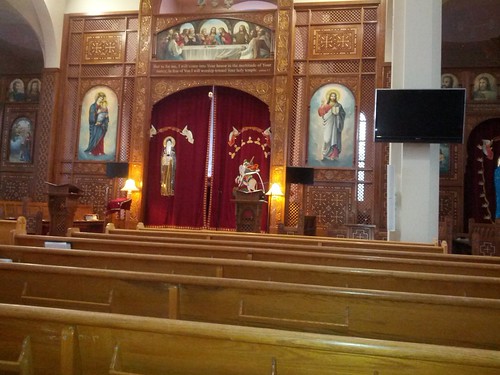
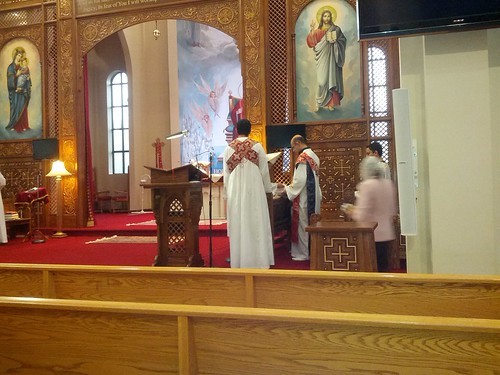
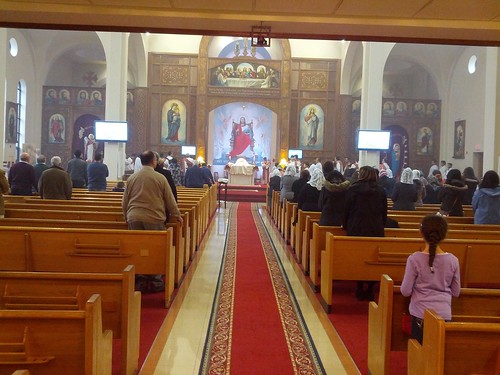
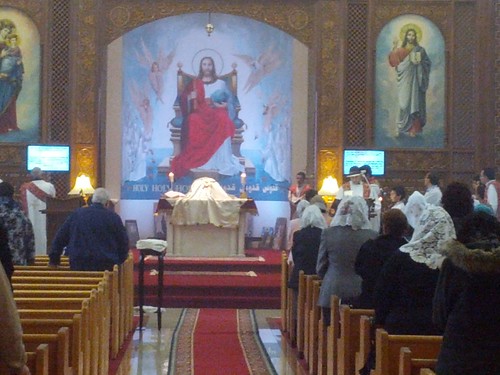
Visit to St George & St Anthony Coptic Orthodox Church

   We just started the "Getting to Know our Neighbour's Faith" small group at the Ottawa Mennonite Church. Today was our first visit. We went to St. George & St. Anthony Coptic Orthodox Church. Their website is http://www.orthodoxy.ca/ . It was a beautiful liturgy. We were welcomed by Fr. Mikhail Fam and Fr. George Mikhail, who invited us to stay after the service and talk, and connect during the week if we wanted.
   Some personal impressions:
- I didn't quite know what to expect when I arrived. The uncertainty of the unknown at times invites a bit of 'fear' ( of 'acceptance', or 'faux pas'). I forgot to ask in advance, for instance, if there were instructions for the dressing costumes, particularly for visiting women of the group. Luckily they had scarfs that served as veil.
- The liturgy is filled with visuals. From the images to the symbols to gestures, it was beautiful to see how rich they were. (In contrast with the Reformed branches of Christianity, many of which removed the symbols as they collided with the alleged 'idolatry' of Roman Catholicism).
- Historically, Reformed churches tried to remove the 'special status' of clergy and laity. In the service at St. George & St. Anthony the Fathers and Deacons were at the front, but looking at the liturgy, the participation of 'clergy' in Reformed churches is not much different in general than what I witnessed.
- Clergy and Deacons at the altar were all male. There might have been about 80 people in the congregation, with a good mix of all ages. A large room with glass allows parents with small children to follow the service.
- I didn't quite know what to expect during the service. I did notice that there was lots of reading of Scripture ( Hebrew Bible and New Testament ). Readings of the liturgy were documented in a book available at the pews and also projected on screens. These readings had the text in Greek, Arabic and English. Readings of Scripture were in Arabic and English.
- The sermon spoke about the Parable of the Sower, which was the reading of the Gospels. To me it sounded clear. I liked it. (It seemed easier to understand and accept what I was hearing, as if I didn't have much 'filters' in my ears for being of a Christian background... ) The Father spoke, among other things, that there were conversations about what it meant for a church to be 'of Jesus Christ'. And that he thinks a church must be 'evangelical' and 'missionary' (in the context of the Parable). Very nice.
- The Father gave us a book and a few booklets about their tradition. The booklets are addressed to youth.

St George & St Anthony Coptic Orthodox Church in Ottawa

St George & St Anthony Coptic Orthodox Church in Ottawa

St George & St Anthony Coptic Orthodox Church in Ottawa

St George & St Anthony Coptic Orthodox Church in Ottawa

Monday, November 05, 2012

SharePoint - Displaying list items with line breaks

This is how you can display list items that have line breaks (based on SharePoint 2010)

1- With SharePoint Designer, open the site and the list.
2- Under the 'Forms' section, open 'DispForm.aspx'.
3- Find the section below and add the fragments in bold:


<asp:Content ContentPlaceHolderId="PlaceHolderTitleAreaClass" runat="server">
<script type="text/javascript" src="https://ajax.googleapis.com/ajax/libs/jquery/1.8.2/jquery.min.js"></script>
<script type="text/javascript" id="onetidPageTitleAreaFrameScript">
if (document.getElementById("onetidPageTitleAreaFrame") != null)
{
document.getElementById("onetidPageTitleAreaFrame").className="ms-areaseparator";
}

// Custom below:
$(document).ready(function() {    
     //var content = $(".ms-rtestate-field").find('div').html();
     $('DIV.ms-rtestate-field').each(function(index) {
        var innerdiv= $(this).find('div');
        if(innerdiv) {
           innerdiv.wrap('<pre/>');
        }
 });
   });

</script>
</asp:Content>


4- Save

Note: to check if the list items are really storing the newline characters, you may use a CAML Query Builder.

Tuesday, October 30, 2012

iOS 6 Ajax bug

As you may have read, there are some bugs in iOS 6 related to Ajax. This post explains it well. I had problems getting the " $.ajaxSetup " option to work, even though I didn't spend much time diagnosing it. Same with " $.ajaxPrefilter " ( see this post )
  While it appears that in Apache you can set the "Pragma: no-cache" just for posts on the server side, in IIS the http headers apply to all methods.
  I opted for creating a specific HTTP module that sets headers to disable client caching for certain specific requests. Here is the C# code:


    using System;
    using System.Web;
    using System.Text.RegularExpressions;

    ///

    /// HttpModule responsible for setting headers to disable cache in case of posts from iPad+iOS6+Safari. This environment may cache Ajax posts. 
    ///
    public class HttpNoCacheModule : IHttpModule
    {
        // user agent regular expression to capture Safari on iPad iOS 6
        private Regex ios6Regex = new Regex(@"iPad.+OS 6.+Safari", RegexOptions.IgnoreCase);

        public void Dispose()
        {            
        }

        public void Init(HttpApplication app)
        {            
            app.EndRequest += new EventHandler(this.OnEndRequest);            
        }

        private void OnEndRequest(Object source, EventArgs e)
        {
            HttpApplication application = (HttpApplication)source;
            HttpContext context = application.Context;
            if (ios6Regex.IsMatch(context.Request.UserAgent))
            {
                if ("POST".Equals(context.Request.HttpMethod))
                {
                    context.Response.Cache.SetCacheability(HttpCacheability.NoCache);
                    context.Response.AddHeader("pragma", "no-cache");
                    context.Response.CacheControl = "no-cache";
                }
            }
        }
        
    }


Tuesday, October 16, 2012

Perguntas Do Dia

É verdade que só os Evangélicos vão para o céu? Explique-me isso.
É verdade que apenas uma denominação está certa e detém a Verdade, a saber, a sua? Explique-me isso.
É verdade que tem algumas religiões que são essencialmente más? Explique-me isso.

Thursday, October 04, 2012

Powershell to generate Delicious graph of tags

Here is a Powershell script that generates a graph in GEXF format of my Delicious tags. GEXF is an XML representation of a graph that may be consumed by Sigma.js, a JavaScript library for rendering graphs.


Set-StrictMode -version 1
Function CreateNode($id, $label, $xmlDoc, $nodes, $rootNS, $ZeroAttributeValue, $OneAttributeValue, $comment)
{
      $node = $xmlDoc.CreateElement("node", $rootNS)
      $node.SetAttribute("id",$id)
      $node.SetAttribute("label",$label)
           
      if ($ZeroAttributeValue) { # occurrences
          $attvalues = $xmlDoc.CreateElement("attvalues", $rootNS)
          $attvalue = $xmlDoc.CreateElement("attvalue", $rootNS)
          $attvalue.SetAttribute("for","0")
          $attvalue.SetAttribute("value",$ZeroAttributeValue)
          $attvalue.AppendChild($xmlDoc.CreateComment('occurrences'))  
          $attvalues.AppendChild($attvalue)
          $node.AppendChild($attvalues)
      }
           
      if ($OneAttributeValue) { # URL
          $attvalues = $xmlDoc.CreateElement("attvalues", $rootNS)
          $attvalue = $xmlDoc.CreateElement("attvalue", $rootNS)
          $attvalue.SetAttribute("for","1")
          $attvalue.SetAttribute("value",$OneAttributeValue)
          $attvalue.AppendChild($xmlDoc.CreateComment('URL'))  
          $attvalues.AppendChild($attvalue)
          $node.AppendChild($attvalues)
      }
 
      $node.AppendChild($attvalues)
      $node.AppendChild($xmlDoc.CreateComment($comment))  
 
      $nodes.AppendChild($node)
}

Function CreateEdge($id, $source, $target, $xmlDoc, $edges, $rootNS)
{      
       $edge = $xmlDoc.CreateElement("edge", $rootNS)
       $edge.SetAttribute("id",$edgeid)
       $edge.SetAttribute("source",$source)
       $edge.SetAttribute("target",$target)
             
       $edges.AppendChild($edge)
}
Function CreateAttributes($xmlDoc, $graph, $rootNS)
{
    $attribs = $xmlDoc.CreateElement("attributes", $rootNS)
    $attribs.SetAttribute("class","node")
    $attrib = $xmlDoc.CreateElement("attribute", $rootNS)
    $attrib.SetAttribute("id","0")
    $attrib.SetAttribute("title","occurrences-node")
    $attrib.SetAttribute("type","integer")
    $attribs.AppendChild($attrib)
    $attrib = $xmlDoc.CreateElement("attribute", $rootNS)
    $attrib.SetAttribute("id","1")
    $attrib.SetAttribute("title","url")
    $attrib.SetAttribute("type","string")
    $attribs.AppendChild($attrib)
    $graph.AppendChild($attribs)
}
Function EqualString($str1, $str2) {
   return !$str1.CompareTo($str2)
}
Function WhiteListTag($tag) {
  $lang = !'português'.CompareTo($tag) -or !'español'.CompareTo($tag)
  $black = (EqualString 'CSN_' $tag) -or (EqualString 'CSN_source' $tag)  -or (EqualString 'CSN_f' $tag) -or (EqualString 'CSN_t_' $tag) -or (EqualString 'CSN_freepage' $tag)
  $hasPrefix = $tag.StartsWith('CSN_')
  return $lang -or ( !$black -and $hasPrefix )
}
[void][system.reflection.assembly]::LoadFrom("E:\install\JsonNetBin\Net35\Newtonsoft.Json.dll")
Add-Type -AssemblyName "System.Net"
$json = ""
Get-Content C:\Users\gustavo.frederico\Documents\jsonDeliciousGF.txt |foreach{$json += $_ + "`r`n"}
$rss = [Newtonsoft.Json.Linq.JObject]::Parse($json)
[xml]$xmlDoc = New-Object system.Xml.XmlDocument
$xmlDoc.LoadXml('')
[System.Xml.XmlNamespaceManager] $nsmgr = $xmlDoc.NameTable
$rootNS = $xmlDoc.DocumentElement.NamespaceURI
$meta = $xmlDoc.CreateElement("meta", $rootNS)
$meta.SetAttribute("lastmodifieddate","2012-09-20")
$xmlDoc.LastChild.AppendChild($meta)
$creator = $xmlDoc.CreateElement("creator", $rootNS)
$creator.AppendChild($xmlDoc.CreateTextNode('CSNombre script'));
$meta.AppendChild($creator)
$desc = $xmlDoc.CreateElement("description", $rootNS)
$desc.AppendChild($xmlDoc.CreateTextNode('gexf representation of Delicious entries'));
$meta.AppendChild($desc)
$graph = $xmlDoc.CreateElement("graph", $rootNS)
$graph.SetAttribute("defaultedgetype","directed")
$graph.SetAttribute("mode","static")
CreateAttributes $xmlDoc $graph $rootNS
$nodes = $xmlDoc.CreateElement("nodes", $rootNS)
$xmlDoc.LastChild.AppendChild($graph)
$csnProps = $rss.Properties() | where { WhiteListTag $_.Name.ToString() }
$existingLabelNodesTags = @{}
# key: tag name , value: tag node id
$existingLabelNodesURLs = @{}
#  key: URL , value: url node id.
$tagNodeId = 0
$edgeid = 0
foreach($prop in $csnProps) {
   $existingLabelNodesTags.Add($prop.Name.ToString(), $tagNodeId)
 
   CreateNode $tagNodeId $prop.Name.ToString() $xmlDoc $nodes $rootNS $prop.Value.ToString() $null 'tag/label node'
     
   $tagNodeId++
 
#   Write-Host $prop.Value.ToString()
}
$wc = New-Object System.Net.WebClient
$edges = $xmlDoc.CreateElement("edges", $rootNS)
$URLNodeId = $tagNodeId
foreach($prop2 in $csnProps) {
   $currentTag = $prop2.Name.ToString()
 
   $tagNodeIdForCurrentTag = $existingLabelNodesTags.Get_Item($currentTag)
 
   $rawJson = $wc.DownloadString("http://feeds.delicious.com/v2/json/gcsfred/" + $currentTag) # "?count=99"
 
   $rawJson = "{ array: " + $rawJson + " }"
   $references = [Newtonsoft.Json.Linq.JObject]::Parse($rawJson)
 
   $referencesProps = $references.Properties()
     
   foreach($refProp in $references['array']) {  
     
       $uVal = $refProp['u'].ToString()
       $dVal = $refProp['d'].ToString()
       # create node for u  , d if it doesn't exist
     
       if ( $existingLabelNodesURLs.ContainsValue($uVal) ) {      
          $nodeIdURL = $existingLabelNodesURLs.Get_Item($uVal)
       } else {
          $existingLabelNodesURLs.Set_Item($uVal, $URLNodeId)
          $nodeIdURL = $URLNodeId        
         
          # create node for u and d
         
          CreateNode $nodeIdURL $dVal $xmlDoc $nodes $rootNS $null $uVal 'URL node'
         
          $URLNodeId++
       }
     
       # now, create edge between currentTag node and URL nodes
       
       CreateEdge $edgeid $tagNodeIdForCurrentTag $nodeIdURL $xmlDoc $edges $rootNS
       $edgeid++
     
       # end of u and d
     
       $otherTags = $refProp['t']
     
       $i=0
       while( $i -lt $otherTags.Count) {
         $otherTag = $otherTags[$i].ToString()
       
         $isWhite = WhiteListTag $otherTag
               
         if (!$isWhite) {
            $i++  
            continue
         }
       
         # fetch node id of $otherTag
     
         $nodeIdOtherTag = $existingLabelNodesTags.Get_Item($otherTag)
             
         CreateEdge $edgeid $nodeIdURL $nodeIdOtherTag $xmlDoc $edges $rootNS      
         $edgeid++
         $i++        
       }      
             
   }
   # end for each reference tag
}
$graph.AppendChild($nodes)
$graph.AppendChild($edges)
$xmlDoc.Save("c:\mytemp\foo.xml")