FB_init

Thursday, July 20, 2006

Emerging Churches: creating christian community in postmodern cultures


Trechos traduzidos do livro "Emerging Churches: creating christian community in postmodern cultures"


p 47"Eu leio os evangelhos vez após vez. Nada do que eu fazia no Domingo era o que eu pensava que Jesus faria se ele estivesse aqui" Joe Boyd, Apex, Las Vegas, EUA

p 66
Desintegrando a divisão entre o sacro e o profano
A sacralização, o processo de tornar a vida toda sagrada, representa a interação entre o Reino e a cultura. As igrejas emergentes rasgam as práticas de igreja que estimulam uma mentalidade secular, a saber, que existem espaços, horas ou atividades seculares. Para as igrejas emergentes, a vida toda deve se tornar sagrada. "Existe uma rejeição inerente na graça do dualismo", diz Jonny Baker (Grace, Londres). A sacralização nas igrejas emergentes tem a ver com uma coisa: a desconstrução da divisão entre o sacro e o secular da modernidade. O período moderno era caracterizado pelo nascimento da idéia de espaço secular, isto é, a idéia de uma dimensão sem Deus. Antes deste tempo, em toda cultura, todas as arenas da vida eram espirituais; era impossível rotular algumas práticas como "religiosas" e outras não. A espiritualidade como uma dimensão separada era desconhecida. Com o nascimento da modernidade no Ocidente, a paridade entre a religião e o resto da vida foi quebrada. Começando com William de Ockham e John Duns Scotus no século XIV, o período moderno criou um lugar secular e relegou as coisas espirituais à igreja. Depois de Descartes, o lugar espiritual cessou de ser a igreja e foi relegado ao coração. A marginalização da prática religiosa continuou até os anos 60 quando muitas das presuposições Ocidentais sobre realidade começaram a ser desconstruídas na cultura. Questões sobre a superioridade Ocidental e "progresso" começaram a ser levantadas. Um desejo por uma espiritualidade que abrangia toda a vida começou a ser ressuscitada. Chame do que quiser, a modernidade tinha a ver com o nascimento de espaços seculares. O pósmodernismo (ou o não-moderno) tem a ver com o sagrado da vida toda. Para igrejas emergentes, quer dizer entregar a vida toda para Deus em adoração, reconhecer o trabalho de Deus em coisas ou atividades não-espirituais anteriormente. Igrejas emergentes marcam esta mudança para uma espiritualidade de "vida toda". Uma conseqüência da criação de uma dimensão secular foi a propensão do modernismo de quebrar tudo em partes pequenas para classificação, organização e sistematização. Portanto, no período moderno, muitos dualismos foram introduzidos na vida da igreja que não eram problemáticos antes: o natural contra o supernatural; fatos púbicos contra valores privados; o corpo versus a mente e espírito; fé verso razão; poder verso amor; e a lista continua. Essas capitulações ao dualismo da modernidade afetou todos os níveis da igreja, incluindo culto, estudo bíblico, estruturas de poder e missões. A cultura pósmoderna questiona a legitimidade desses dualismos. De igual forma, as igrejas emergentes se opõem fortemente a cada uma dessas divisões modernas. O Método Holístico das Igrejas Emergentes As igrejas de novos paradigmas, com propósito, de caçadores, e da geração X não são pósmodernas neste sentido. Esses movimentos veneram os grandes encontros e o coração como domínios espirituais principais. Não desafiam os muitos dualismos da modernidade mas ao invés continuam com as divisões entre o natural e o supernatural, individual e comunitário, mente e corpo, público e privado, fé e ação, e elas deixam as estruturas de controle de poder como estão. Nesses movimentos, a religião e as práticas espirituais são atividades que uma pessoa pratica fora da cultura, e a espiritualidade fica ainda às margens. Pelo contrário, a proclamação da igreja emergente está no Salmo 24.1: "Do Senhor é a terra e a sua plenitude". Para igrejas emergentes, não existem mais lugares ruins, pessoas ruins ou tempos ruins. Tudo pode se tornar santo. Tudo pode ser entregue a Deus em adoração. Todos os dualismos modernos podem ser superados. As igrejas emergentes encarnam o desejo de remover espaços seculares. Para essas comunidades, não existem domínios não-espirituais de realidade. Esse levante em espiritualidade reflete a morte do secular à medida que a sociedade move para além do modernismo racionalista. "Espaço secular é como uma bolha sobre muitas águas. É uma lugar de onde Deus foi excluído. Eu não acredito em 'secular'. Não deve existir", diz Steve Collins da Grace (Londres). Ben Edson (Sanctus1, Manchester, Reino Unido) também rejeita a noção de divisão entre secular e sagrado. "Nós tentamos criar pontes que se estendem sobre a divisão entre o secular e o sagrado porque nós não fazemos esta distinção. Nós usamos música secular no culto bem como filme e literatura. Espero que sejam pontos de conexão entre o quotidiano das pessoas e suas fés." As igrejas emergentes reconhecem o sagrado de tudo na vida e procuram desmantelar tudo que é secular.

p. 73
Simon Hall do Revive (Leeds, Reino Unido) compartilha sua experiência sobre a superação dos aspectos modernos do culto carismático. "Eu acho que uma das maiores tensões dentro do Revive é tentar previnir a fuga carismática da realidade no culto. Eu lembro de trabalhar numa igreja urbana quando tinha meus 20 anos, tentando fazer as pessoas cantarem músicas sobre suas vidas, e a atitude deles era 'Nós vimos aque tentar fugir das nossas vidas!' Estou tentando mudar isso, porque a conseqüência é que a fé e a vida real se tornam completamente separadas". Verdadeiramente, a adoração que focaliza exclusivamente na celebração e transcendência podem terminar por ignorar as questões não-resolvidas e conflitos que as pessoas vivem e conduzí-las mais à negação. Mas ao mesmo tempo, reconhecer Deus apenas nas coisas criadas é ignorar a diferença de Deus e sua transcendência, aspectos do caráter de Deus vistos nas Escrituras. Igrejas emergentes recusam a escolha falsa do secular moderno, sem votar em liberais ou conservadores. Elas reconhecem o trabalho profundo de Deus na realidade material enquanto ao mesmo tempo aceitam a realidade invisível de Deus.

p. 78 Igrejas emergentes trazem o corpo de volta ao culto. Enquanto a Reforma removeu vários rituais do culto, o culto pósmoderno restora essas atividades. A Reforma focalizou na palavra falada, enquanto o culto pósmoderno escolhe a palavra experimentada. [...] Igrejas emergentes criam suas próprias músicas, como no Portal de Salomão em Mineápolis, onde eles também praticam as orações de yoga, massagem e física. Eles crêem que o que é bom para o corpo físico é bom para o corpo espiritual e vice-versa.

p. 81
Bandas de Rock e Músicas de Clubes Nas igrejas emergentes, especialmente no Reino Unido, há uma tendência que se afasta da forma de igreja do tipo banda de rock onde os músicos lideram o louvor do palco. Louvor rock'n'roll - cujos pioneiros foram a Vineyard e outros movimentos, convida os ouvintes a olhar para o palco para ter direção. A maior parte do foco está nas pessoas lá na frente, mesmo se os ouvintes são conduzidos a focalizar em Deus. Embora cânticos ainda sejam cantados em várias igrejas emergentes, eles não são sempre a forma principal como essas igrejas experimentam o louvor. Ao invés, a música serve como um apoio para outras atividades como oração, silêncio, e liturgia. No louvor da cultura de clube, a música envolve os adoradores, que talvez nem vejam o DJ. A pessoa não focaliza na plataforma em frente; de fato, talvez nem haja uma plataforma. Steve Collins (Grace, Londres) compara o estilo inerente do louvor da cultura de clube com um tipo de louvor neotestamentário, pós-templo, que enfatiza o tipo de louvor imanente sobre o qual Jesus falou à mulher no poço. Na música de clube, a pessoa se sente imersa na presença de Deus. As raízes da influência da cultura de clubes nas igrejas remonta ao Reino Unido nos anos 80. Collins conta sua história: "Eu era um freqüentador de clubes na metade dos anos 80 e vi o início da cultura rave em 1988. Senti Deus no dance floor, não na igreja, e no final do 'culto' me senti limpo". Seus amigos freqüentadores de clubes buscaram a presença de Deus e acharam-na no clube. Para Collins, uma questão tomou-o: "Por que a igreja não está ligada nessa subcultura?" Ian Mobsby (Moot, Londres) explica o nascimento do louvor alternativo: O louvor alternativo foi inicialmente uma reação contextual à cultura rave. Ele apresentou uma forma de ser igreja que nasceu da vibração comunitária dos clubes e raves. Isso, para mim, era principalmente uma "Garagem Gospel": de repente eu estava adorando a Deus em um lugar muito desigrejado. Foi uma mudança de paradigma, o qual vários outros experimentaram, penso eu. Então uma nova forma de ser e fazer igreja nascera no louvor alternativo. O alternativo era um movimento cultural no final dos anos 80 que foi muito liberador para alguns até que ele foi para as drogas. Então o louvor alternativo cresceu contextualmente assim.

p. 89
Em uma ocasião, depois de gastar horas com ela no Salão, o café da igreja, um visitante perguntou à Karen Ward (Igreja dos Apóstolos, Seattle):- "A que horas é o culto da sua igreja?"- "Você acabou de assistí-lo", respondeu Karen.

p. 93
As igrejas emergentes desafiam a prioridade do indivíduo assumida em igrejas dos caçadores, de novos paradigmas e até mesmo Protestantes tradicionais. Este desafio é visto mais claramente no culto pósmoderno, especialmente na club music encontrada principalmente no Reino Unido. Não é simplesmente um novo tipo de música. O evento experimentado no clube necessariamente envolve expressão comunitária e participação ativa de todos. Pelo contrário, nos cultos com soft rock ou hard rock, os indivíduos geralmente ignoram outros membros da igreja enquanto cada pessoa focaliza em Deus e os membros da banda. No louvor da cultura de clube, os participantes não ignoram seus amigos mas se tornam amigos viajantes numa experiência "muito próxima" de Deus. Eles experimentam Deus em associação com seus amigos e também passam pela experiência juntos. É um evento compartilhado que une as pessoas e torna-as mais próximas. A rede Mudança Cultural utiliza a cultura de clubes como sua forma principal de adoração, e também é usada no louvor alternativo e vários movimentos missionários independentes como o Tribe em Manchester (Reino Unido). À tempo, não estamos dizendo que a cultura de clube é a única forma de adorar na cultura pósmoderna. As maneiras são infinitas, e essas várias expressões são exploradas nos capítulos sobre participação, criatividade e espiritualidade.

Friday, July 14, 2006

Concrete Abstract Algebra : From Numbers to Gröbner Bases

Concrete Abstract Algebra : From Numbers to Gröbner Bases (Paperback)
Publisher: Cambridge University Press (October 16, 2003)
ISBN: 0521534100

page 3:
"1.1 The natural numbers and the integers
The natural numbers 1,2,3,... were handed over to mankind by God (in the words of Kronecker (1823-91)). Mankind later added the important natural number 0."

Sunday, June 25, 2006

voodoo with COM

Voodoo with COM! Yes, to work with COM you need some voodooing. For instance, if you just want to have an application to change the navigation in an IE instance, you will need voodooing and it won't work. I tried getActiveObject to get a running instance of IE and, of course, it doesn't work. I tried then to create a new IE object but when I try a simple IWebBrowser2 method like navigate I get a nice "unknown runtime error" with error code 0x80004005. The event viewer says "
Faulting application iexplore.exe, version 7.0.5346.5, faulting module ssv.dll, version 5.0.60.5, fault address 0x0000248b." Is it because it's IE 7 beta? Probably not.
Regardless, it's very difficult to work with COM to do basic tasks. What if all I want is to talk to a running instance? getActiveObject and its ROTten table don't seem to work, and I tried in more than one occasion.

Thursday, June 15, 2006

IBM Irrational


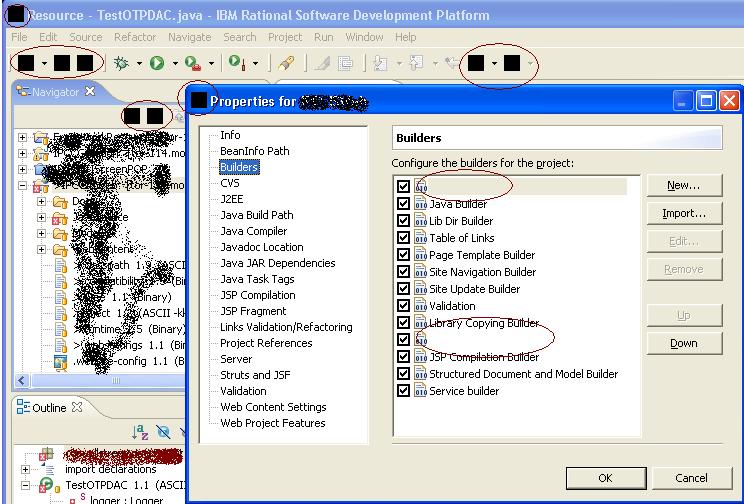
This is IBM Irrational. Look at the black icons. Look at the blank entries in the dialog. See how it can't fine java.lang.Object. See how I can't deploy an application. Beautiful. No wonder people can't use computers.

Wednesday, June 07, 2006

"How to Score"


"How to Score" reveals the secret science that lies behind 'the beautiful game'. From international team formations to the psychology of the pitch and the changing room, Ken Bray describes the influences that impact upon play. He answers many of football's hottest questions: what is the perfect way to take a free kick? Which players are under more stress; attackers, midfield, or defenders? How do we know when a ball has crossed the goal-line? And, how can teams win a penalty shoot out? "How to Score" analyses many of the most memorable games over the last 50 years and the tactics of our favourite international and local footballers, as well as touching on big scientific themes such as aerodynamics, computer simulation and game analysis, via a brief journey into football's history. Drawing on the latest research from the fields of physics, biology, physiology, computing and psychology, football's hidden rules are illuminated like never before. From down the pub to up on the terraces, we love to talk about football - "How to Score" is essential reading for anyone who wants to understand the game's secrets.

Publisher: Granta Books
ISBN: 1862078327

Thursday, June 01, 2006

Saturday, May 27, 2006

Musique du geste

"Musique du geste
Prendre garde au geste musical, c'est délier l'écoute et le regard, soustraire à la vue pour être attentif au mouvement musical.
"

Tuesday, May 23, 2006

Cisco no meu olho

Buenas, que coisa ruim. Esse software da Cisco (que eu não posso falar o nome, mas começa com c depois tem t depois tem i depois o depois s) é ruim, ruim.
CTransport::RecvMessage msg too big length msgLength = 851969
É isso aí. A mensagem é muito grande.

Saturday, May 20, 2006

Conversando com um representate da comunidade acadêmica

Foi mais uma daquelas conversas interessantes.
"Ó mestre: na aula vimos que as variáveis podem ser independentes ou não. Se duas variáveis forem dependentes existe uma aproximação linear. Usando a covariância podemos então transformar o espaço de entrada. Fizemos isto para podermos usar classificadores baysianos otimizando a distância entre as classes."
"Isso mesmo. Só quero que você escreva mais sobre o assunto."
"Mas veja bem: eu estou fazendo outra coisa. Uso um outro classificador. Pra eu eu ia querer fazer esse processo todo no meu caso?"
"É, bem... tem razão... só escreve um parágrafo e está bem... deixa pra lá. Escreve mais no capítulo 4 então."

Mais uma vez, a comunidade acadêmica em função do próprio umbigo e sem pensar na finalidade das coisas. Chega tanto a esse extremo que quando eu reuso software e técnicas eles acham que eu não criei nada. É porque reinventar a roda é bem-visto no meio acadêmico, enquanto resolver problemas é secundário.

C4.5 Programs for Machine Learning

C4.5 Programs for Machine Learning by J. Ross Quinlan. Que livro chinelão.

Saturday, May 06, 2006

when the light has gone (dba)

when the light has gone
and the darkness falls around you
when the stillness comes
is there someone there to find you...

i drift to sleep
in the comfort of peace
but I remember the time
when I cried in the night
the burning tears that wet my face
run through my fingers
like an acid rain

its been the longest day
just being on my own

when the light has gone...

i dream of truth
as I reach for the jewel
now the hum in my ears
is the sound that I hear so faintly
the coldest wind that bit my skin
falls strangely silent from it's within

it's been the longest day
just being on my own

when the light has gone...

Friday, May 05, 2006

Agora 2006 - Instruments virtuels


Systèmes adaptatifs et interaction
Au cœur de la conférence NIME 06 consacrée aux nouvelles interfaces pour l'expression musicale, cette session entend donner la parole aux entreprises et centres de recherche qui innovent en développant des systèmes de plus en plus réactifs et des interfaces tels le dispositif Lemur de la société Jazz Mutant.

Saturday, April 29, 2006

Feature & tooth extraction

Feature extraction, tooth extraction, feature selection, constructive induction, feature extraction, feature transformation, feature discovery. Ai minha cabeça.

Friday, April 28, 2006

Vinde a mim

"Vinde a mim, todos os que estais cansados e oprimidos, e eu vos aliviarei.
Tomai sobre vós o meu jugo, e aprendei de mim, que sou manso e humilde de coração; e encontrareis descanso para as vossas almas. Porque o meu jugo é suave e o meu fardo é leve."

Friday, April 14, 2006

How was your weekend?

- How was your weekend?
- Oh it was great. We had a barbecue, we went to the cinema, we saw some friends, blah blah blah. What about you?
- Oh it was great. I studied Friday until 3 in the morning. Then I studied the whole day Saturday until 3 in the morning. Then I went to Church Sunday morning. Then I studied the rest of Sunday until 6 in the morning when I went to sleep. Then my daughter woke me up with a duck whistle at 8 AM having slept 2 hours I went to work at 9 to begin fresh a week in an exciting and challenging working environment where they value me very much and make very good use of my skills and knowledge.

Research community II

The 'research community' definitely is out of touch with the world. First, I've never seen any other activity where individuals work in so much isolation and lack of cooperation. Nobody seems to have any interest in each other's work, or collaborate in any way. Then, they are so interested in their own research that they disregard their end result. Like a comment I had in one of my rejected papers that said that it would provide good understanding of the problem domain but the performance with other publications couldn't be compared (of course, because it's was an innovative publication). The means become the end. I'm really looking forward to finishing this thing.

Tuesday, March 21, 2006

Is there life?

Is there life after a Master's thesis?

Error

No wonder people don't know how to use computers. Right now, MS Word is telling me "Error! Objects cannot be created from editing field codes." What did I do to you, Mr. Word, for you to tell me that?

Friday, March 10, 2006

categorical nonsense

"3.1. The language of categories is affectionately known as abstract nonsense. This
is essentially accurate, and not necessarily derogatory: categories refer to nonsense
in the sense that they are all about the ‘structure’, and not about the ‘meaning’, of
what they represent. The emphasis is less on how you run into a specific set you
are looking at, and more on how that set may sit in relationship with all other sets.
Worse (or better) still, the emphasis is less on studying sets, and functions between
sets, than on studying ‘things, and things that go from things to things’ without
necessarily being explicit about what these things are: they may be sets, or groups,
or rings, or vector spaces, or modules, or other objects that are so exotic that the
reader has no right whatsoever to know about them (yet). "
http://www.math.fsu.edu/~aluffi/courses/2005-6/MAS5307/GRV.pdf

Sunday, March 05, 2006

Trinity

Math is like God the Father, Music is like God the Son, and Computer Science is like God the Holy Spirit. They are three persons, but one God under the Godhead.

Friday, March 03, 2006

Therefore, G*d exists

When you see complex ideas, when you are amazed by it and kind of understand it but doesn't quite get it, you can try to put a "Therefore, God exists" at the end. Maybe you can even contemplate its mystery, but you probably don't get it. Try it, and you will get interesting sentences. Maybe that will comfort you.
For example, there are symbols, signs, syntax, grammars, Chomsky categorization of grammars, rules and semantics. It's all related. Therefore, God exists.
Another one: a problem can be NP-complete, computable in polynomial time, etc. Therefore, God exists.
There is category theory, abstract algebra, topology, discrete geometry without any figures (!), morphisms, generators, homotropy, cohomology and the Yoneda lema. Therefore, God exists.
You can transform matrices into polynomials into equations. Therefore God exists.
All of a suden you'll begin to admire science and believe in something by faith.
Or you can end a sentence with "therefore, the world will end". For example,
you can completely understand one object through all morphisms or something like the Yoneda lema. Therefore, the world will end.

Wednesday, February 22, 2006

The Music Theory Handbook

I found a very good book about Music Theory. It's the Music Theory Handbook, by Marjorie Merryman (ISBN 0-15-502662-3). It's a thin book that has lots of good things, including what I need!

Tuesday, February 14, 2006

Bluetooth

I was trying to get Bluetooth software to work these days. It's very complicated. And the documentation from software APIs is poor. And the documentation from hardware manufacturers is terrible. The examples are incomplete. The problem with Bluetooth doesn't seem to be related to the hardware. It seems to be related to the terrible software. The intention is good, though. The profiles are a nice idea. I just with they worked.

Monday, February 06, 2006

Topological spaces

"For any algebraic objects we can introduce the discrete topology, under which the algebraic operations are continuous functions. This leads to concepts such as topological groups, topological vector spaces, topological rings and local fields."
Kool! That means I can have a discrete topology and define continuous functions in it. And the continuous functions are the algebraic operations. And there's more: any function from a discrete topological space to another topological space is continuous.

Thursday, January 26, 2006

Is there any merit or purpose in computing on discrete musical objects?

SVMs project the data from the original domain into some (possibly infinite) Hilbert space and then use a REAL-VALUED function f: X -> R for discrimination, so that if f(x) >= 0 then x is labeled positive class, and negative otherwise. f(x) is a linear discriminant in this projected Hilbert space (aka feature space), and thus can be expressed as an inner product in the feature space, so that f(x) = <> + b. Now skipping lots of details, in the original space, it can be shown that if your function is of the form f(x) = sum(i=l..m)a[m]y[m]k(x[m],x) + b and the kernel function k has certain properties you don't even need to know what is the mapping and it is guaranteed that it exists and that there's some inner-product space in that feature space. The codomain of this kernel function is either R (the reals) or C (complexes). (Be careful about the word "kernel" here. I still haven't figured out how the "kernels" in SVMs relate to "kernels" in algebra.)
So I thought: "Ok, if I can express musical objects as an inner-product, then I can let these SVMs compute directly on music". HOWEVER, I had a problem with the musical objects. Note that k: (X,X) -> R and k(x,x') = <> (phi is the projection from X to the Hilbert space). The inner product space is a vector space. A vector space is a module over a ring. In SVMs the ring is the field R, the reals. For this module, I can probably model my musical objects in the input domain X as an abelian group. My problem is the scalar multiplication of the module R x X -> X. How can I have the reals multiplying inherently discrete musical structures resulting in discrete musical structures and still maintain vector and scalar distributivity? For example, what does pi x {0,4,7} (a chord) mean?
Then I assumed that it wouldn't work this way. I began to think that perhaps I could form a free module over an ordered ring instead of a vector space, and create an inner-product using Milnor's definition of
inner product, which doesn't require the bilinear's codomain to be a field. That can take care of the domains in the SVM theory. But the theory only has R as the codomain. That's the assumption. I could try to see if I could enhance the SVM theory to allow Z as the codomain. Specifically, that amounts to taking a serious look at Mercer's theorem and finding alternative ways for the kernel function to fulfill certain properties assuming that the codomain is a commutative ring. But before going down that quest, I wonder if this is of any interest to the research community. Is it of interest to find ways to compute directly on musical objects? For instance, I remember how Elaine Chew projects the musical objects in that spiral in some continuous space, with some geometric calculations there. I remember David Temperley's center of gravity in the line of fifths, which again is non-discrete. I'm more interested in the discrete representations. I'll understand Mazzola after three reincarnations as a math PhD student, four as a musicologist and two as a philosopher (note: reincarnations somewhere in Europe, somewhere between France and Switzerland). But it seems that the foundation is so general that the musical objects may be represented by anything.
I see the nice discrete structures in the works from Mazzola, Andreatta, Forte and Noll. For me they are just there waiting for machines to compute directly on them by glueing their theories. But I still can't answer whether there's any merit, purpose or any benefit in doing that. I'm looking mainly for pragmatic answers to this question rather than philosophical answers (if possible). Comments are also welcomed.

Saturday, January 21, 2006

What is music? - wikipedia answers that (or does it?)

From Wikipedia, on the definition of music:
"[there are] those that seek a platonic or quasi-platonic ideal of music which is not rooted in specifically physical or mental terms, but in a higher truth. "
[...]
"The platonic ideal of music is currently the least fashionable in the philosophy of criticism and music, because it is crowded on one side by the physical view - what is the metasubstance of music made of, if not sound? - and on the other hand by the constructed view of music - how can one tell the difference between any metanarrative of music and one which is merely intersubjective? However, its appeal, finding unexpected mathematical relationships in music, and finding analogies between music and physics, for example string theory, means that this view continues to find adherents, including such critics and performers as Charles Rosen and Edward Rothstein."

Friday, January 20, 2006

Music and Mathematics course

Here's the Syllabus of an Music and Mathematics course given by John Rahn. Kool stuff. Very kool stuff. All these algebraic structures are there waiting for us to compute directly on them.
http://faculty.washington.edu/jrahn/5752004.htm

Thursday, January 19, 2006

The research community doesn't understand the customer

Folks in the Machine Learning 'research community' could think a bit more about their 'customers'.
It's a generic problem in academic research. In private companies you learn fast that the customer is king. In the 'academic community', though, they are more interested in their own problems and tend to ostracize the applications and users.
For example, Machine Learning helps users classify/rank their data. It should help the users understand their problem domain. There are two areas that I don't see evolving in Machine Learning.
First in feature selection, their ultimate goal is to optimize the set of attributes for classification. But in doing so, the process can reveal a lot about the problem domain itself. I can't find much interpretation in the literature of how to utilize the result of feature selection to interpret the original problem domain. For instance, the literature uses a lot of Information Theory, but it doesn't show how much information the attributes convey conditionally on the class.
The second symptom of the problem is again the assumption that you are always dealing with the Euclidean space. Mercer's theory in SVM assumes a vector space. They definitely should work with better abstract algebra and category theory to redefine their theory, so that the machines can manipulate other objects directly.

Tuesday, January 10, 2006

Rio de Janeiro - Elza Soares

Rio de Janeiro, gosto de você

Rio, Rio de Janeiro, cortado por montanhas
Mares desespero cortado por favela bala fuzila fuzileiro suicida dominantes das alturas guerrilheiros capitais
Guerrilheiros capitais
Formado o aparteid social que provoca o vazio preenchido pela droga
Da sociedade que explora o consumo ali do cidadão

Rio de Janeiro, gosto de você

Rio, Rio de Janeiro, cortado por montanhas
Mares de maneiro
Rio, Rio de Janeiro, cortado por montanhas
Mares de maneiro
Metropolitano brasileiro que mandou
Gasta dinheiro carioca de origem
Trabalha no sinal mas não metralha

Rio de Janeiro, gosto de você

Premiado pelo mundo simpatia tá na cara do turista enlouquecido na beleza guanabara

I love, I love, I love, I love you

Rio de Janeiro, gosto de você

Monday, January 09, 2006


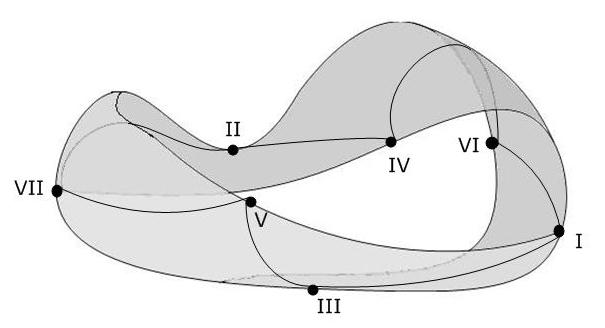
And here it is, the famous harmonic möebius strip, based on Schönberg's harmonic strip. Kool! ( I still can't understand how Mazzola created a nerve starting with the major, melodic minor and harmonic minor scales. )

Saturday, January 07, 2006

on kernels with integers as codomain and not a field, using Milnor's bilinear function

The problem of generalizing Kernels as functions with integers and not reals as codomain is in Mercer's theorem. The problem is that the theorem begins assuming that the Kernel function has the reals and complexes as codomain. Using Milnor's definition of a bilinear function that becomes an inner product space, and the non-degenerative restriction, I can construct a Kernel-like function that works with a free module instead of a vector space. But then, how can I be certain that it will have all the properties expected of a Kernel function for SVMs?

Wednesday, January 04, 2006

The Blank Sheet Desperation, The Student Nightmare

Among the worst despairs someone can have, one is called The Blank Sheet Desperation. It's the state of despair one faces in front of a blank sheet. It's because the person has all the ideas and has to start writing. The person has to have all the main ideas in order to begin. And how to encode correctly the ideas? Think of all the models that are isomorphic to the ones in your head.
This fear is similar to The Student Nightmare. The Student Nightmare is a dream like this: the student is in the classroom and doesn't remember there was a test. And then he/she gets The Test, and he/she knows no answer. It's a terrible nightmare. I read somewhere that it is The Student Nightmare because it happens to all students and there's no other nightmare that compares to it.

Céu, sol, sul

Eu quero andar nas coxilhas sentindo as flexilhas das ervas do chão
Ter os pés roseteado de campo ficar mais trigueiros como o sol de verão
Fazer versos cantando as belezas dessa natureza sem par
E mostrar pra quem quizer um lugar pra viver sem chorar

É o meu Rio Grande do Sul céu, sol, sul terra e cor
Onde tudo que se planta cresce o que mais floresce é o amor
É o meu Rio Grande do Sul céu, sol, sul terra e cor
Onde tudo que se planta cresce o que mais floresce é o amor

Eu quero me banhar nas fontes e olhar horizontes com Deus
E sentir que as cantigas nativas continuam vivas para os filhos meus
Pelos campos florindo e crianças sorrindo, felizes a cantar
E mostrar pra quem quizer um lugar pra viver sem chorar

Monday, January 02, 2006

Schenkerian Analysis

It would be nice to have my system to compare the results of genre classification between one piece and one of its Schenkerian reductions. But I can't find any MIDI file or any encoding that has the Schenkerian version. If you find one, let me know!

Tuesday, December 27, 2005

Perspectives in mathematical and computational music theory

I'm adding some more books to read AFTER my Thesis

Title: Perspectives in mathematical and computational music theory / [edited by] Guerino Mazzola, Thomas Noll, and Emilio Lluis-Puebla.
Publisher: Osnabrück : Epos, Electronic Pub. Osnabrück : University of Osnabrück, c2004.
ISBN 392348657X

And two other books on Topology:
Experiments in Topology by Stephen Barr, and General Topology by John L. Kelley
Maybe one of these two books will make Topology accessible to me, with good examples (and figures)

Monday, December 19, 2005

Java and Web Services

I just downloaded the Java package for web services - the Java Web Services Developer Pack. I couldn't use it. I just want to write a web services client out of a WSDL. I just want to generate the client. But I have to download a big J2EE web container. Then I need to understand how a certain service registry works. Then I'll need to have all that going and launching here and there from command line. Then I'll have to fight with CLASSPATHs including 1001 .jar files, and version of this XML package, and that other one. And after 10 hours it won't work. I hope it's easier with Microsoft .NET. I wish I could import the WSDL in Visual Studio .NET, or run some kind of wizard there.

Saturday, December 17, 2005

www.ontologicalreviews.com

I should patent the idea quickly. www.ontologicalreviews.com will be a big hit. Now the elections campaign is ongoing. In www.ontologicalreviews.com people would be able to assess their candidates better. They could get 'best voted' formulas. They could vote on the evaluation formulas themselves too. Besides the canned reports, people would be able to use an applet or an ActiveX control to easily increase/decrease the parameters and assess the alternatives. Just imagine a control labeled 'Gomery scandal damage' and a percentage besides it. Or 'spending with military' - 15 % (default or best voted percentage) , 'environmental platform' - 5 % (default or best voted percentage), 'National unity' - 20 %, etc

Capitalism vs Socialism

"In capitalism men exploit men. In socialism it's the other way around." ( I don't know the source )

Wednesday, December 14, 2005

On beeing a "cold" Canadian

As typical north-americans, Canadians can be seen as 'colder' in general than Brazilians. Not that being "colder" is bad. Not at all! It's just different from other cultures. At least with regards to public behaviour. I think two things contribute to this behaviour:
- cold weather and driving distances. Because the weather is colder, people interact with each other in different ways. Canadians don't just hang outside during Winter... So it's natural to interact differently with people. Driving distances are also responsible in part for the 'problem'. If you walk around your neighbourhood odds are you'll get to know your neighbours better. I have a feeling that Canadians hate smalltalk with neighbours.
- static chocks. Yes, static chocks make Canadians "colder" people towards each other. That's because you avoid kissing other people because of static chocks.